
Current Challenges in the Sunscreen Formulation Industry
Sunscreen formulations rely on two key raw materials—nano-zinc oxide and titanium dioxide—which are prone to agglomeration during storage and mixing. Agglomerated particles result in a poor skin feel, such as a heavy texture or an unnatural white cast. Furthermore, when powders are clumped together, a significant portion is trapped within the aggregates, rendering them ineffective at blocking UV rays. Storage stability is another critical issue; finished products often suffer from sedimentation or phase separation over time.
Solutions Offered by Ultrasonic Homogenizer Technology
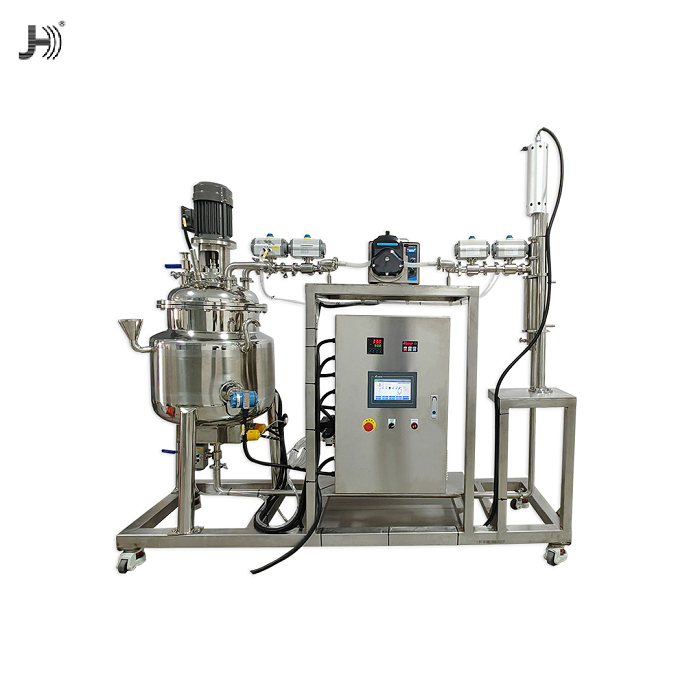
Unlike conventional stirring, which struggles to break down agglomerates, ultrasonic processing utilizes high-shear forces generated by acoustic cavitation to disperse powder aggregates and restore particles to their primary size. Uniform dispersion enhances UV scattering and reflection efficiency, thereby reducing raw material consumption. Ultrasonic treatment improves the stability of the finished sunscreen, minimizing sedimentation and phase separation during long-term storage while ensuring greater consistency in fineness and performance across batches.
Benefits of Ultrasonic Processing
It breaks down agglomerates of nano-zinc oxide and titanium dioxide, resulting in a smoother application that feels lightweight and non-sticky, without an unnatural white cast or pilling. It enhances UV protection, stabilizes SPF performance, and lowers raw material costs. By ensuring uniform particle dispersion and significantly improving stability, it extends the shelf life of the product and reduces the scrap rate. Additionally, as ultrasonic homogenizer processing is a physical dispersion method that does not require grinding media, there is no risk of contamination from grinding debris, resulting in a purer final product.
Ultrasonic processing yields sunscreens that feel lighter and more comfortable on the skin, offer superior UV protection, exhibit better storage stability, and reduce raw material costs.
Operational Precautions
1. Temperature control (water-cooling circulation systems can be used).
2. Dry running (operating the ultrasonic probe without immersion) is strictly prohibited; the probe must be fully submerged in the slurry before activation to prevent transducer damage. Do not position the probe too close to the bottom of the tank to avoid cavitation-induced damage to the vessel.
3. Protect the titanium alloy probe from impacts or scratches by hard objects; thoroughly clean the probe between production runs involving different formulations to prevent cross-contamination.
4. Regularly check the integrity of the double-layer jacket; if the inner shell is damaged and slurry seeps into the interspace, the machine must be shut down immediately for inspection and repair.
Post time: Aug-14-2026