
conventional shearing struggles to further reduce droplet size, resulting in large particle sizes and a system prone to phase separation and oil surfacing. Standard emulsification processes require high pressures or prolonged high-speed agitation, generating significant heat that degrades heat-sensitive nutrients and flavor compounds, leading to flavor loss and reduced nutritional value. Maintaining emulsion stability often necessitates large quantities of emulsifiers and thickeners, thereby increasing raw material costs. Fluctuations in material viscosity and pressure instability can lead to significant batch-to-batch variations in droplet size, resulting in inconsistent mouthfeel and stability in the final product. High-pressure emulsification equipment is prone to wear and can introduce trace metal contaminants. Emulsifying high-viscosity materials is particularly challenging, often requiring multiple processing cycles, which extends production times and increases energy consumption.
Solutions Offered by Ultrasonic Technology
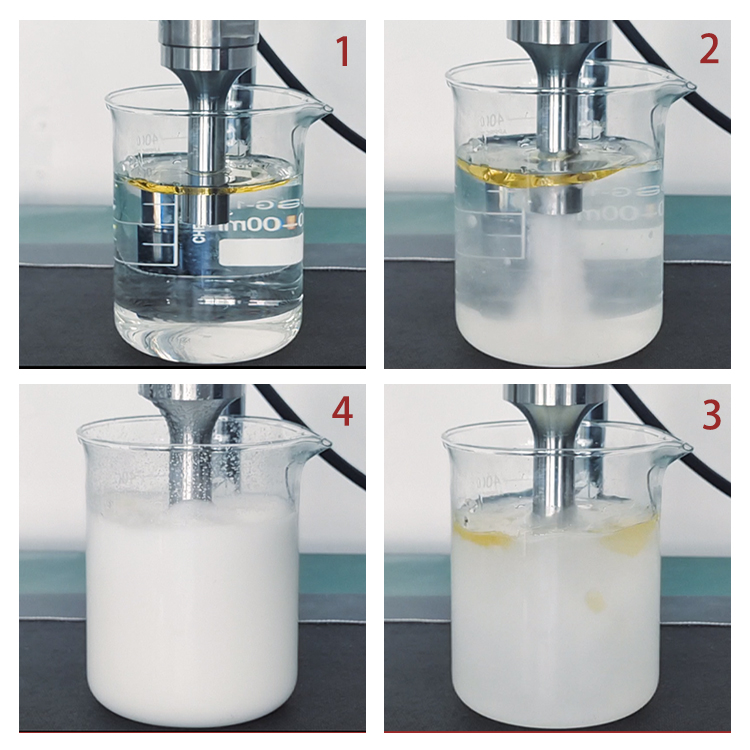
Ultrasonic technology utilizes the cavitation effect to generate micro-jets, intense turbulence, and instantaneous shear forces. These forces break the oil phase into minute droplets, achieving micro- or nano-scale emulsification; the resulting droplets are smaller and more uniform in size, significantly enhancing the stability of the emulsion system. A closed-loop ultrasonic process combined with a jacketed water-cooling system allows for low-temperature emulsification, minimizing the thermal degradation of flavor compounds and bioactive nutrients while preserving the food’s original aroma and nutritional profile. Ultrasonic emulsification also enables a reduction in the dosage of emulsifiers and thickeners, simplifying ingredient lists and optimizing formulation costs. The process eliminates wear-prone components like high-pressure valves, preventing metal contamination from mechanical wear. It ensures high consistency across batches regarding droplet size, mouthfeel, and stability, and is suitable for various food emulsion systems, including oil-in-water and water-in-oil types.
Benefits of Ultrasonic Processing
Ultrasonic emulsification mixer produces a fine, uniform emulsion with a narrow particle size distribution, making the product resistant to phase separation and oil surfacing, thereby significantly extending shelf life. Low-temperature processing minimizes the degradation of nutrients and flavor compounds, resulting in a richer aroma and better nutrient retention. A reduction in emulsifier dosage lowers formulation costs and simplifies the ingredient list. As the equipment lacks high-speed grinding components, the risk of impurity contamination is low; this leads to higher product yields and greatly improved batch-to-batch consistency. Fewer emulsification cycles shorten production time and reduce overall energy consumption.
Summary
Ultrasonic mixer achieves efficient micro-emulsification, refining emulsion droplets and enhancing storage stability. Low-temperature, closed-system operations preserve flavor and nutrients, allow for reduced emulsifier usage, and eliminate contamination from wear-related impurities. The process is easily standardized, ensuring consistent batch quality while lowering energy consumption and production costs.
Precautions
1. Use an intermittent pulsed ultrasonic mode; avoid prolonged, high-power continuous sonication, as excessive treatment can cause lipid oxidation and protein degradation, leading to emulsion breakdown and off-flavors.
2. Strictly control system temperature using a dual-layer water-cooling/thermostatic system to prevent localized overheating, lipid oxidation, and the destruction of flavor compounds.
3. Use food-grade titanium alloy or 316L stainless steel for components in contact with the product.
4. Promptly clean the probe, piping, and tank after production to prevent microbial growth from residual material and avoid cross-contamination.
5. For food systems containing alcohol or volatile solvents, utilize a closed production process and implement appropriate explosion-proof measures and workshop ventilation.
Recommended the suitable ultrasonic mixer
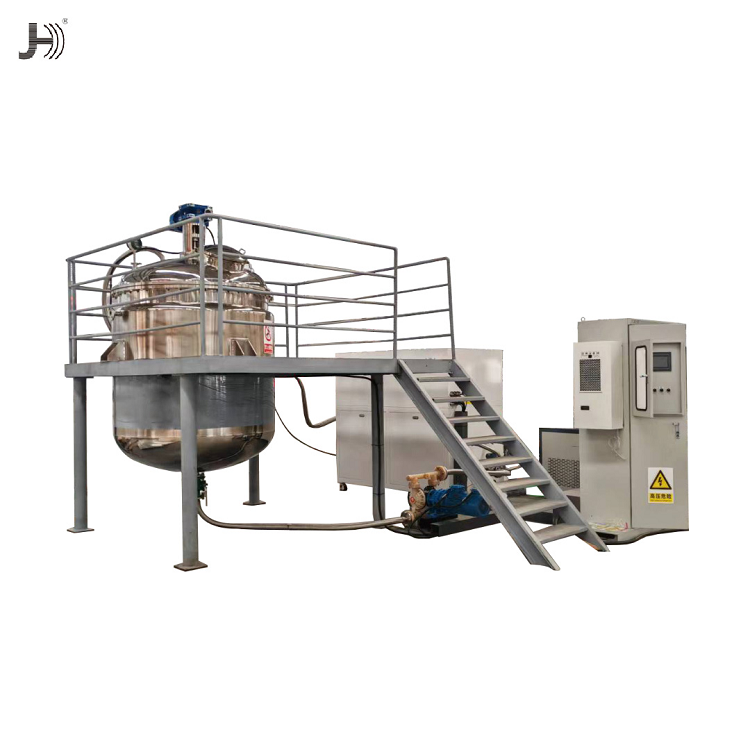
Utilizes a closed-loop ultrasonic emulsification process, relying on ultrasonic cavitation to achieve micro-emulsification of oil and water phases; eliminates the need for high-pressure homogenization valves, thereby avoiding contamination from valve component wear. Equipped with a pulsed-intermittent ultrasonic mode and a dual-layer water-cooling constant-temperature system, the process maintains controlled low temperatures throughout. This preserves flavor and nutrients while allowing for reduced emulsifier usage. Process parameters can be saved as recipes, facilitating easy switching between different products. Production capacity is customizable; a single unit handles 250–700 L/h, and multiple units can be networked in parallel to achieve a combined capacity exceeding 1.8–3 tons/hour, making it suitable for upgrading production lines in food processing facilities of all sizes (customizable to specific line requirements).
Ultrasonic Food Emulsification Case Study
Raw Materials: Oil-in-water flavored milk (edible vegetable oil + water + food flavoring)
Original Process: Pre-mixing via agitator followed by high-pressure homogenization; multiple homogenization cycles were time-consuming. Oil-water compatibility was poor, leading to oil droplet separation and uneven particle sizes; the emulsion tended to separate or develop an oil slick upon standing. High levels of emulsifiers were required to aid emulsification, increasing production costs.
Ultrasonic Process: Inline constant-temperature pulsed ultrasonic emulsification equipment was installed on the existing line and connected in a sealed manner to the mixing tank. The pre-mixed oil-water solution enters the ultrasonic circulation system for inline emulsification, requiring minimal modification to the original production line.
Measured Results
1. Droplets are thoroughly micronized with a more uniform particle size distribution; emulsion separation and oil slick formation are significantly reduced, enhancing product shelf stability.
2. Low-temperature emulsification minimizes the breakdown of heat-sensitive flavor compounds, resulting in a natural, full-bodied aroma and better nutrient retention.
3. Emulsifier dosage is moderately reduced, lowering the overall production cost of the formulation.
4. Absence of valve wear eliminates the risk of metal contamination, increasing the yield of high-quality finished products.
5. Fewer homogenization cycles are required, shortening processing time and reducing energy consumption.
Post time: Oct-13-2026