
Traditional chemical degradation processes rely on oxidizing agents to break the long chains of polysaccharides. These processes readily introduce chemical residues and make it difficult to precisely control the molecular weight range; as a result, the molecular weight distribution is broad and the moisturizing activity exhibits significant fluctuations. In high-shear homogenizers operating in the high-shear mode, the shear intensity cannot be finely adjusted, making localized excessive chain cleavage, loss of viscosity control, and degradation of activity likely. In compounded systems, when hyaluronic acid is blended with peptides, plant extracts, lipid raw materials, and inorganic fillers, the high-molecular-weight gel solution has high viscosity, making mass transfer and mixing difficult and resulting in poor system homogeneity. During storage, the mixture is prone to stratification and particle agglomeration and sedimentation. During stirring and homogenization, a large number of microbubbles are continuously introduced; because the hyaluronic acid gel solution has high viscosity, these bubbles have difficulty rising and being expelled. After filling, the finished product exhibits poor permeability and bubble defects, which affect the appearance of single-use liquid formulations, wound-care gels, and nanoemulsions. In conventional homogenization processes, temperature increases are difficult to control. The polysaccharide chains in hyaluronic acid are temperature-sensitive: elevated temperatures accelerate random molecular degradation, leading to batch-to-batch variations in viscosity, molecular weight, and moisturizing performance. To improve dissolution and dispersion, formulations often contain large amounts of solubilizing and dispersing additives, thereby increasing raw-material costs. Excessive additives can also alter the film-forming properties, transdermal performance, and mechanical properties of the hyaluronic acid gel, thereby reducing the user experience of the finished product.
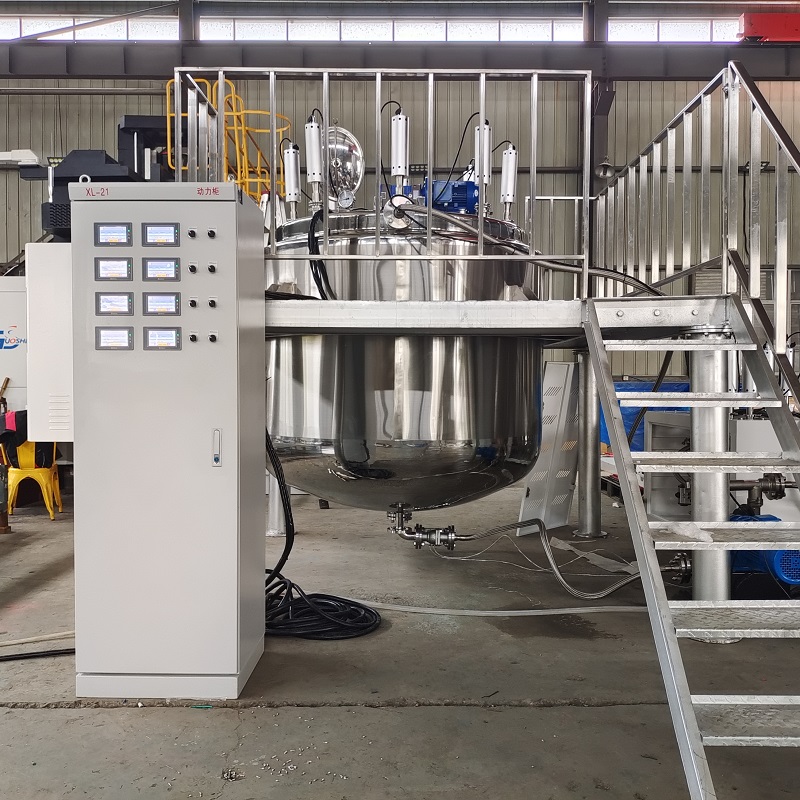
Principle of ultrasonic dispersion
By leveraging the liquid-phase cavitation effect, microjets, and controllable high shear forces, ultrasonic treatment generates alternating positive and negative acoustic pressure fields within the aqueous hyaluronic acid system. The impact forces generated by the instantaneous collapse of cavities, together with the precise action of microjets, tear apart the dry-powder aggregates and disrupt the agglomerated powder structures within the composite system, thereby achieving uniform hydration and dissolution as well as nanoscale fine dispersion. This process relies entirely on physical mechanisms and involves no contact with grinding media, thereby preventing medium wear and impurity contamination at the source. Using pulse-controlled energy input and a constant-temperature coupling process, the ultrasonic energy input is precisely controlled. This enables the controlled breaking of glycosidic bonds in the polymer hyaluronic acid, allowing the directional production of medium-and low-molecular-weight hyaluronic acid with the desired molecular weight. At low-energy settings, the process can simply disperse the aggregates and achieve homogeneous mixing without damaging the main hyaluronic acid chain or the cross-linked gel network structure, thereby preventing the degradation of active components. Ultrasonic dispersion also provides deaeration: it promotes the collision and coalescence of tiny air bubbles in the gel solution, causing them to rise and be expelled, while simultaneously improving the issue of slurry entraining microbubbles. Compared with the limitations of chemical degradation—residual byproducts, significant temperature rises during high-shear homogenization, and uncontrollable shear forces—the ultrasonic dispersion process offers adjustable parameters and can perform online dispersion in mixing tanks and circulating pipelines. It can be used to solubilize dry hyaluronic acid powder, homogenize and deaerate the feed solution, and prepare HA nanomicelles, liposomes, and composite hydrogels. It can also integrate controllable-degradation units of polymer HA into existing production lines with minimal modifications. The process is compatible with various hyaluronic acid clean systems intended for cosmetic-grade, pharmaceutical dressing-grade, and medical aesthetics-grade applications.
The actual effects following ultrasonic dispersion treatment
The hyaluronic acid dry powder aggregates undergo complete hydration and dispersion, with no fish-eye spots observed. The dissolution time is significantly reduced, and the uniformity of the gel solution is improved, thereby reducing defects such as particles and flocculent matter during subsequent filling and molding processes. No grinding media are used throughout the process, so no external impurities are introduced; the gel solution achieves higher cleanliness and is suitable for high-cleanliness processes involving skincare ingredients, wound dressings, and medical aesthetic ingredients. Under pulse-controlled energy input and supporting constant-temperature cooling conditions, the temperature rise of the system is controllable, and the degradation of hyaluronic acid molecular chains is highly controllable. The molecular weight distribution is narrow, and viscosity and moisturizing activity remain stable, with minimal batch-to-batch performance variation. Compared with traditional chemical degradation and prolonged stirring for homogenization, this process shortens the production cycle, reduces the use of chemical reagents, and lowers the costs associated with auxiliary agent procurement and post-processing. Once the slurry has dispersed, internal microbubbles are simultaneously removed, improving the permeability of the solution and reducing the likelihood of bubble-related defects during filling. The formulation allows for reduced addition of solubilizing and dispersing auxiliaries, thereby minimizing their interference with the film formation, transdermal penetration, and gel mechanical properties of hyaluronic acid. This enhances the product’s skin feel and storage stability, while slowing system stratification and the re-aggregation and sedimentation of particles. The equipment supports intermittent cycling and online continuous dispersion, making it suitable for use from laboratory-scale formulation development through industrial-scale mass production. Its strong compatibility with clean-process conditions helps ensure the consistent quality of high-end hyaluronic acid raw materials and facilitates formulation optimization.
sum up
By leveraging the physical properties of ultrasonic cavitation-induced microjets and high-frequency controllable shear, this approach specifically addresses key production challenges: the difficulty in dissolving aggregated hyaluronic acid dry powder, residual material remaining after chemical degradation, loss of control over molecular weight under high shear conditions, uneven mixing within the system, bubble formation in the slurry, fluctuations in batch performance, and the high用量 of additives. It enables efficient hydration of hyaluronic acid dry powder, controllable degradation of high-molecular-weight HA, and homogeneous emulsification of the composite system. This ensures the stability of hyaluronic acid activity and viscosity, as well as high cleanliness; reduces production time; lowers additive costs; and improves the yield of the final product and its storage stability.
matters need attention
1. Immersion-type ultrasonic vibration rods must under no circumstances operate unloaded. The working surface of the vibration head must be submerged below the level of the adhesive liquid before the equipment is started, in order to prevent cavitation damage to the probe and to extend the service life of the titanium-alloy vibration element.
2. The hyaluronic acid molecular chains are sensitive to shear energy: excessively high energy levels or continuous operation over a prolonged period can easily lead to excessive fragmentation of the polysaccharide chains, resulting in a decrease in viscosity and activity.
3. Ultrasonic treatment generates continuous heat; hyaluronic acid is highly heat-sensitive, so the process must be accompanied by constant-temperature cooling. The operating temperature must be strictly controlled within the range permitted by the formulation to prevent viscosity drift and loss of activity.
4. The hyaluronic acid gel has a high viscosity and tends to dry and solidify when left undisturbed; therefore, stringent cleanliness requirements must be met. After production, promptly rinse the probe, pipelines, and buffer tank with purified water or the appropriate solvent to prevent the gel from drying and solidifying, adhering to surfaces or precipitating as particles. This helps ensure stable ultrasonic output and maintains the cleanliness of the gel.
5. The production of pharmaceutical-grade and medical aesthetics-grade hyaluronic acid raw materials must comply with cleanroom control requirements. The ultrasonic dispersion workstation shall be equipped with a cleanroom environment, and appropriate protection measures shall be implemented for the raw materials to prevent external contamination.
Recommended Equipment
Ultrasonic dispersion units are categorized into immersion ultrasonic dispersion systems and online circulating ultrasonic dispersion units. They are compatible with dissolution and blending tanks, compound reaction tanks, and circulating pipeline stations. These units cover a range of applications, from laboratory-scale pilot systems and pilot-scale units to industrial units capable of high-volume mass production. They can be directly integrated into existing hyaluronic acid formulation, homogenization, and post-processing production lines, requiring minimal modifications to the existing lines. They support the dissolution of hyaluronic acid dry powder, controlled degradation, homogenization, emulsification, and degassing, as well as the enhancement of quality control.
application case
Raw material: sodium hyaluronate (HA) polymer raw material
Original process: HA dry powder is added to pure water and stirred for an extended period to allow swelling and dissolution; the resulting aggregates contain many fish-eye-like particles, and dissolution takes a long time. The molecular weight is adjusted via chemical oxidative degradation; residual oxidizing agents require an additional step for removal. The molecular weight distribution is broad, and there are significant variations in viscosity and moisture-retention performance across multiple batches. Stirring introduces a large number of microbubbles; the permeability of the raw solution is poor, and the number of bubbles during filling is relatively high. After peptide and plant extracts are compounded, the mixture does not blend uniformly, and after storage for a period, separation and coarsening tend to occur. The amount of additives used is high, limiting the scope for formula adjustments; consequently, the yield for high-end single-use orders is relatively low.
Ultrasonic process: Following preliminary mixing of the pure water, the slurry is introduced into the ultrasonic dispersion unit after the materials are added. The process is carried out with constant-temperature cooling and in pulse mode: ultrasonic treatment first breaks up the dry powder gel aggregates, enabling hydration and dissolution; the ultrasonic energy is then adjusted to achieve controlled degradation. Dispersion is completed simultaneously with ultrasonic degassing; the material is subsequently filtered and discharged. The new and existing processes are integrated in a collaborative production approach, thereby reducing the use of dispersion, solubilization, and auxiliary agents.
Measured results
1. The HA dry powder gel particles dissolve completely and fully disaggregate, with no fish-eye white spots; the dissolution time is significantly shortened, the uniformity of the gel solution is improved, and defects such as particulate flocculation are substantially reduced.
2. The process relies solely on physical degradation; there are no residual oxidizing agents, and the cleanliness of the adhesive liquid meets the requirements for the production process of high-end skincare ingredient formulations.
3. Production cycle time is shortened, eliminating the costs associated with purchasing chemical degradation reagents and the removal processes. Microbubbles within the slurry are removed simultaneously, resulting in a decrease in the defect rate of filling bubbles.
4. The dosage of the dispersing and solubilizing aid can be reduced; the film-forming properties and transdermal performance of hyaluronic acid improve, the storage stability of the liquid formulation increases, and layering, coarsening, and sedimentation are slowed down.
5. The equipment supports both intermittent and continuous online operation, is suitable for the clean production of hyaluronic acid, is simple to operate and maintain, and offers high formula compatibility. It meets the mass-production control requirements for hyaluronic acid intended for cosmetic and wound-dressing applications.
Post time: Nov-26-2026