
The nano materials ultrasonic homogenizer disperser is a core piece of equipment for achieving uniform dispersion of nanomaterials. Its dispersion effect directly determines the application performance of nanomaterials (such as stability, reactivity, and particle size uniformity). Due to the large specific surface area and tendency of nanoparticles to aggregate, precise control of equipment parameters, operating procedures, and material characteristics is necessary to achieve the ideal dispersion effect. This article, combined with practical scenarios, clarifies the core control points for dispersion effect, facilitating efficient and stable dispersion operations.
I. Equipment Parameter Control (Core Key)
1. Ultrasonic Homogenizer Power Adjustment
Power is a core parameter affecting the dispersion effect. It needs to be flexibly adjusted according to the type of nanoparticles, particle size, and material viscosity to avoid excessively high or low power.
Low ultrasonic homogenizer power (50%-70% of rated power): Suitable for nanomaterials with smaller particle sizes (10-50nm) and lower viscosity. This avoids excessive power leading to particle breakage and degradation, while also preventing excessive bubble generation that could affect dispersion uniformity.
High ultrasonic homoegnizer power (70%-90% of rated power): Suitable for nanomaterials with larger particle sizes (50-200nm) and prone to agglomeration (such as nanopowders and nanoslurries). Strong ultrasonic vibration breaks up particle agglomerates, achieving uniform dispersion. However, prolonged full-power operation should be avoided to prevent equipment overload and material deterioration.
Adjustment principle: Follow the principle of “from low to high, gradual adaptation.” After startup, preheat at low power for 1-2 minutes, then gradually increase the power according to the dispersion state until the ideal effect is achieved.
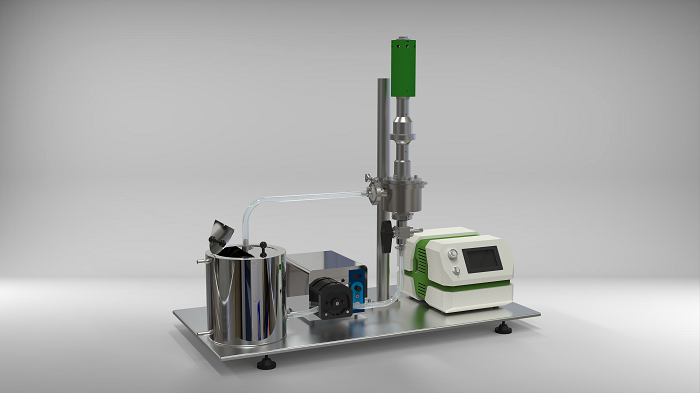
2. Ultrasonic disperser time control
The ultrasonic dispersion time needs to be matched with the power and material characteristics. Longer is not necessarily better; excessive ultrasonication can lead to secondary agglomeration or breakage of particles.
Regular dispersion: For easily dispersible nanosolutions (such as nano-oxide solutions), a ultrasonic time of 10-20 minutes is sufficient to achieve uniform dispersion.
For difficult-to-disperse materials: For high-viscosity, highly agglomerated nanomaterials (such as carbon nanotubes and graphene nanoparticles), the ultrasonic time can be extended to 30-60 minutes, with 2-3 pauses (5 minutes each) to prevent overheating and maintain dispersion.
Key Reminder: The material temperature must be monitored during ultrasonication. If the temperature exceeds 60℃, the machine should be stopped immediately for cooling to prevent changes in nanoparticle properties.
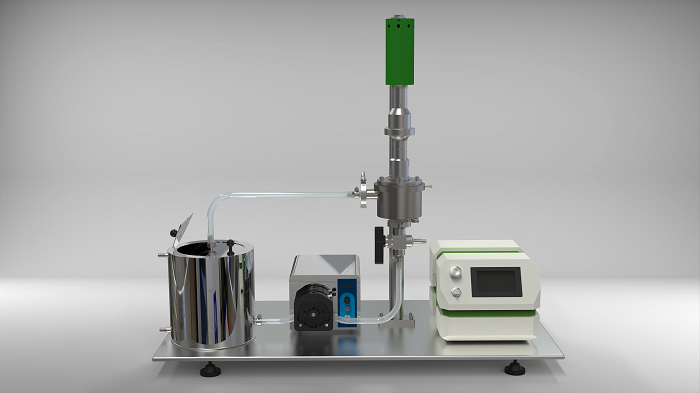
3. Ultrasonic Homogenizer Disperser Frequency Selection
The frequency of nanoscale ultrasonic dispersers is typically between 20kHz and 100kHz. Higher frequencies result in higher dispersion precision but weaker penetration; lower frequencies result in stronger penetration but slightly lower dispersion uniformity.
For fine-particle-size nanomaterials (≤50nm): High frequencies (60kHz-100kHz) are preferred for finer dispersion and reduced particle agglomeration.
For coarse-particle-size, high-viscosity materials (≥50nm): Low frequencies (20kHz-40kHz) are preferred to enhance ultrasonic penetration and break up large agglomerates. II. Material Characteristic Control (Basic Guarantee)
Post time: Apr-03-2026