
Depositing highly uniform functional thin films on advanced substrates represents a fundamental engineering requirement in photovoltaic solar cell and semiconductor manufacturing. Traditional pneumatic spray nozzles and hydraulic atomizers rely on high-pressure air streams that generate turbulent spray plumes, uneven coating thicknesses, severe droplet bounce-back, and fluid overspray exceeding 50% to 80%. Implementing a precision ultrasonic spray coating system replaces turbulent pressure atomization with acoustic vibration, producing an ultra-fine, low-velocity droplet mist that adheres evenly across fragile substrates. Hangzhou Precision Machinery Co., Ltd. (JH) manufactures advanced ultrasonic coating systems and non-clogging atomizing nozzles engineered to eliminate pinholes, maximize raw material utilization, and deliver sub-micron layer control across industrial production lines.
Drawing from 15 years of specialized ultrasonic homogenizer and acoustic engineering at JH, resolving film deposition defects requires peeling back the core layers of fluid atomization mechanics and substrate interaction dynamics. Industrial coating engineers must examine how turbulent gas jets induce kinetic bounce-back compared to gentle acoustic capillary wave excitation, while evaluating how narrow droplet spectrums under 0.5 m/s eliminate pinhole formation. In addition, analyzing unpressurized large-orifice nozzle architectures reveals how acoustic micro-vibrations prevent tip clogging in high-solid slurries, while precision low-pressure carrier gas shaping establishes uniform film deposition across solar cells and functional glass substrates.
Pneumatic Hydraulic Splashing vs Acoustic Capillary Atomization
In conventional pneumatic spraying, pressurized liquid is forced through a tiny orifice and shattered by high-velocity compressed air streams traveling at several hundred meters per second. This violent kinetic collision generates extreme aerodynamic turbulence around the coating zone, dispersing fine droplets uncontrollably into the surrounding environment. The high impact velocity causes droplets to bounce off the substrate rather than wet the surface smoothly, creating irregular film build-up, surface orange peel, and substrate contamination while wasting costly functional precursor solutions.
JH ultrasonic precision spraying and atomization systems eliminate high-pressure air blast mechanics entirely by utilizing ultrasonic mechanical vibrations through precision titanium alloy nozzles to destabilize liquid surfaces. Liquid introduced onto the vibrating nozzle tip forms a thin fluid film that absorbs acoustic energy without experiencing hydraulic shearing forces. Because the atomization process occurs under ambient pressure conditions without compressed air turbulence, spray plume exit velocities remain below 0.5 m/s. This gentle soft-spray velocity allows droplets to settle quietly onto delicate substrates, achieving coating uniformities above 95% while saving up to 80% of functional materials by virtually eliminating overspray, fluid waste, and bounce-back during continuous deposition runs.
Capillary Wave Physics and Narrow Droplet Size Distribution
Achieving consistent thickness in thin-film solar cells and functional optical coatings requires precise control over aerosol droplet diameter and size distribution. Pneumatic nozzles produce wide polydisperse droplet spectrums ranging from sub-micron satellite droplets to large millimeter splatters, which creates uneven drying rates and structural pinholes across functional layers. These drying irregularities degrade light absorption in perovskite solar cells and impair conductivity in transparent conductive oxide films.
JH precision ultrasonic coating systems operate by generating standing capillary waves on the atomizing surface driven by an ultrasonic homogenizer ultrasonic homogenizer assembly. When acoustic amplitude exceeds the liquid surface tension threshold, the crests of these standing waves collapse and release micro-droplets of tightly uniform diameters. Every ultrasonic nozzle operates at a defined resonant frequency between 20kHz and 120kHz, which dictates the droplet spectrum; for instance, a 60kHz nozzle produces a median droplet size around 20 microns (10–45µm range). This narrow droplet distribution ensures consistent solvent evaporation, uniform film consolidation, and precise dry film thickness control ranging from 20 nanometers to 100 microns across large-area substrates, perovskite solar cells, and fuel cell membrane electrode assemblies (MEAs).
Unpressurized Large-Orifice Architecture and Clog-Free Liquid Delivery
Nozzle clogging is one of the most disruptive failure modes in industrial thin-film deposition lines handling functional slurries, carbon nanotubes, conductive inks, or polymer suspensions. Traditional pressure nozzles rely on microscopic orifices under 0.5 mm that rapidly become obstructed by particle agglomeration, polymer drying, and tip crusting, forcing frequent production shutdowns for manual cleaning. Periodic clogging alters liquid flow rates unpredictably, resulting in dry zones and severe film thickness variations across production batches.
JH ultrasonic nozzles feature a wide central feed channel and an unpressurized open atomizing tip manufactured from high-purity, corrosion-resistant titanium alloy metallurgy. Liquid is delivered to the spray head via gravity or high-precision programmable syringe pumps under low pressure, accommodating various chemical precursors, functional slurries, and suspensions. Continuous high-frequency acoustic vibrations prevent particles from agglomerating on the nozzle tip, providing a maintenance-free, self-cleaning atomization mechanism that operates without mechanical wear, internal moving seals, or clogging hazards across extended commercial manufacturing campaigns.
Precision Gas Shaping and Controlled Thin-Film Deposition
While ultrasonic atomization creates a soft, low-velocity mist, precise thin-film deposition requires controlled trajectory guidance to deposit coatings onto specific target geometries. Without directional airflow management, the gentle acoustic aerosol cloud could drift randomly, compromising coating edge definition and pattern accuracy across automated motion stages.
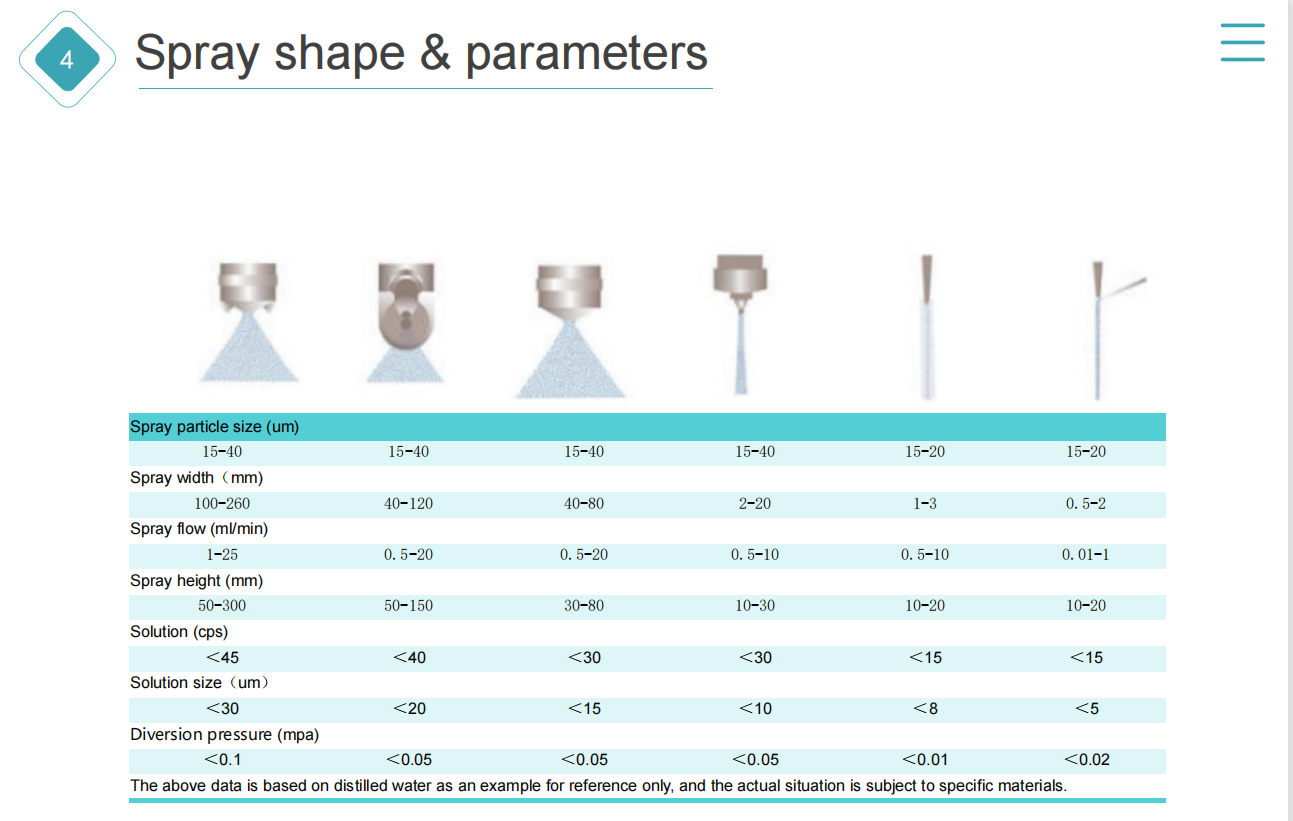
JH solves this deposition challenge by integrating precision low-pressure carrier gas channels surrounding the ultrasonic atomizing head. Depending on targeted coating patterns, nozzles can be configured with convergent, divergent, or spiral gas-shaping geometries operating under low diversion pressures (≤0.15 MPa). By dynamically balancing gas-liquid matching, operators can focus the soft aerosol plume into a fine 2 mm line for micro-circuits or expand it into an ultra-uniform wide pattern for broad photovoltaic sheets, eliminating edge over-accumulation and ensuring sharp coating boundaries.
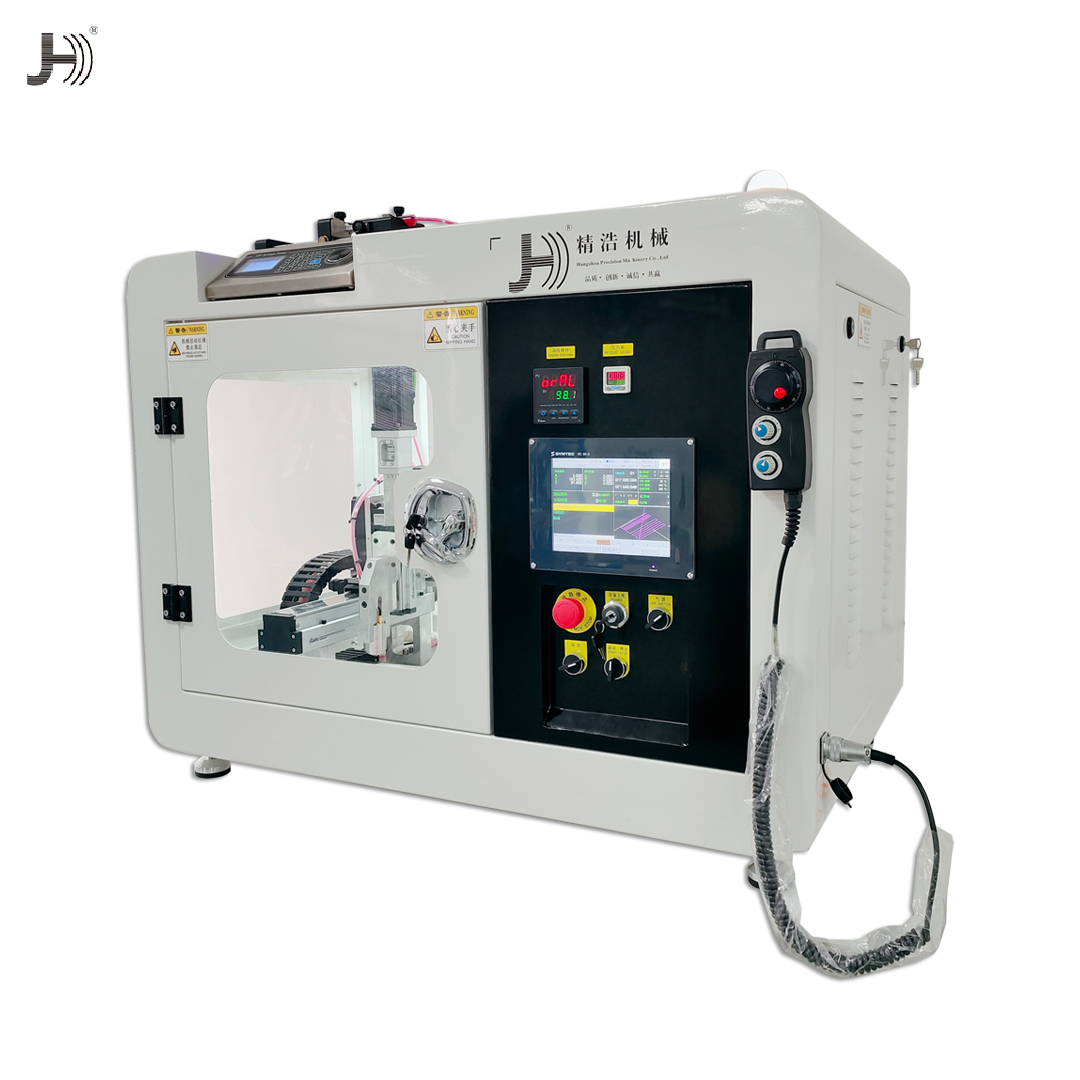
JH Factory-Direct Ultrasonic Coating Integration from Benchtop R&D to Inline Production
Successfully scaling thin-film deposition recipes from laboratory proof-of-concept to high-volume commercial manufacturing demands dependable hardware architecture with repeatable acoustic control. JH provides a complete spectrum of precision ultrasonic spray solutions, spanning benchtop laboratory coating stations for recipe formulation, automated multi-axis XYZ motion systems for pilot testing, and multi-nozzle inline deposition arrays for high-throughput solar and glass processing.
For specialized thin-film development (such as the JH-TWG05 platform), systems can be equipped with XYZ three-axis servo positioning, unrestricted G-code motion programming, integrated ultrasonic homogenizer slurry dispersion to prevent solid settling, and multi-zone vacuum substrate heating plates up to 500°C. Backed by digital frequency-tracking generators and precise amplitude regulation, JH ultrasonic systems deliver consistent acoustic energy transfer across variable liquid viscosities, ensuring smooth recipe transition from laboratory research to full-scale commercial manufacturing with complete process predictability.
Conclusion
Replacing turbulent pneumatic sprayers with precision ultrasonic coating systems enables manufacturers to achieve superior thin-film uniformity, unpressurized clog-free reliability, and raw material savings of up to 80%. Backed by 15 years of ultrasonic homogenizer innovation, precision titanium metallurgy, and CE certified manufacturing standards, JH delivers advanced spray coating solutions tailored to the rigorous demands of photovoltaic solar cells, fuel cells, functional glass, and advanced electronics. Each system provides precise micro-flow delivery, controllable aerosol plume geometry, and dependable 24-hour continuous operation across demanding commercial production environments, establishing a reliable standard for modern thin-film deposition.
To request technical specifications for precision ultrasonic spray coating systems, atomizing nozzle plume geometries, substrate coating trial data, or customized multi-axis system quotations for your production lines, visit the official company portal: https://www.hzpmsonic-en.com/. For direct technical consultations regarding thin-film deposition parameters, perovskite solar cell coating, conductive ink atomization, and automated inline production integration for manufacturing facilities, contact the engineering sales department.
Post time: Sep-01-2026