
In fields such as new materials, chemicals, pharmaceuticals, and new energy, powder dispersion, emulsion homogenization, and nanoparticle processing have always been crucial steps affecting product performance and experimental repeatability. Traditional methods such as stirring and ball milling are prone to problems like particle agglomeration, uneven dispersion, and particle size destruction. Ultrasonic homogrnizer dispersers, leveraging the physical action of ultrasound, achieve gentle, efficient, and controllable dispersion, becoming a core piece of equipment from laboratory pilot-scale testing to industrial-scale production.
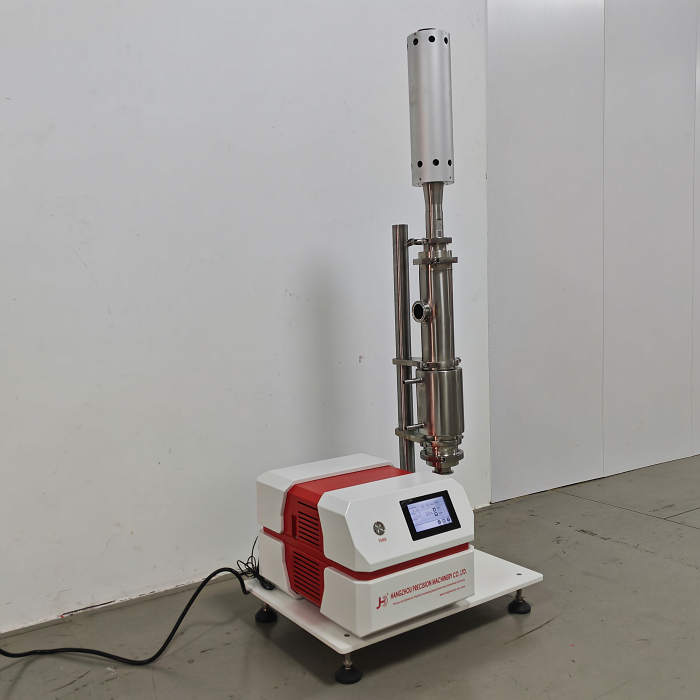
Ultrasonic homoegnizer utilize high-frequency ultrasound to generate cavitation effects in liquids, creating instantaneous microjets and high-pressure impacts that effectively break up particle agglomerates, ensuring uniform dispersion of materials in the medium. Compared to traditional equipment, it offers more uniform dispersion, more controllable particle size, shorter processing time, and is less prone to introducing contamination. It is particularly suitable for high-precision materials such as nanomaterials, graphene, carbon nanotubes, ceramic slurries, and pharmaceutical suspensions.
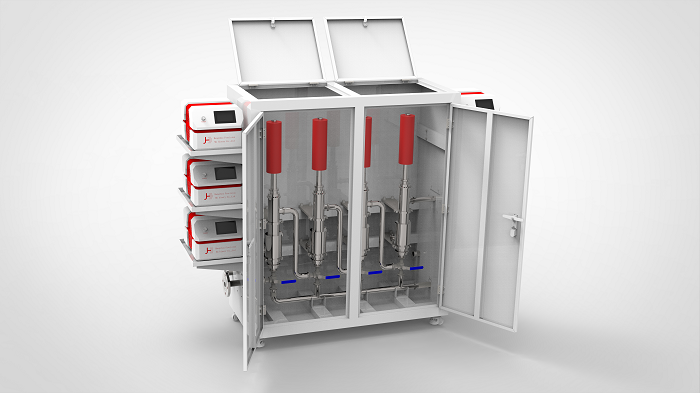
In the laboratory stage, ultrasonic dispersers are compact and have adjustable parameters, enabling formulation exploration, small-scale experiments, and mechanistic studies. They can precisely control ultrasonic power, time, and amplitude, facilitating the acquisition of stable data and providing reliable data for subsequent scale-up.
Entering the pilot-scale and scale-up production stages, the ultrasonic homogenizer can achieve continuous flow, high power, and large-scale processing, maintaining laboratory-level dispersion effects while increasing throughput. Its high stability, ease of cleaning, and compatibility with various processes effectively reduce risks during scale-up, truly achieving seamless integration of experimental results with mass production.
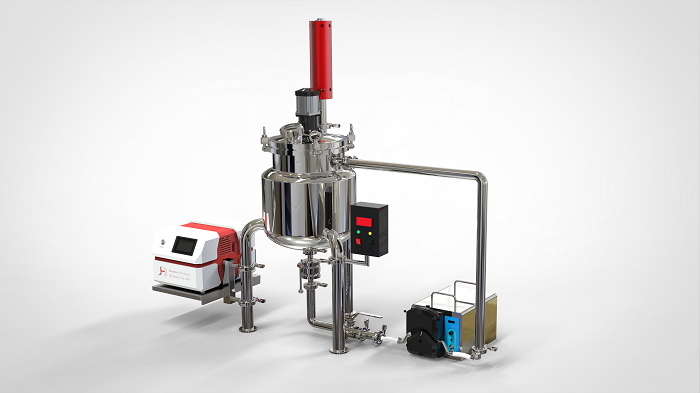
Overall, the ultrasonic disperser combines the precision of laboratory work with the scale-up capabilities of pilot-scale production. It boasts high dispersion efficiency, ease of operation, and wide applicability, offering significant advantages in new material development, new energy slurries, pharmaceutical formulations, and coatings and chemicals. It is a crucial piece of equipment for improving the quality and efficiency of modern R&D and production.
Post time: Apr-08-2026