
In fields such as nanomaterials, new energy batteries, advanced ceramics, and biomedicine, the ability to achieve nanoscale particle size and uniform dispersion is critical to product performance. Traditional mechanical stirring and milling techniques often struggle when dealing with systems characterized by strong agglomeration or high viscosity. Sonochemical ultrasonic dispersion technology, leveraging the unique “cavitation effect,” offers a highly efficient physical solution to these industry challenges. This article provides an in-depth analysis of the core value of sonochemical ultrasonic dispersion homogenizer, covering its underlying principles and industrial applications. Hangzhou Precision Machinery Co.,Ltd.(JH) Specializing in ultrasonic dispersion and homogenization technology for over 15 years, the company offers a comprehensive range of equipment systems, spanning from laboratory-scale units to industrial production lines.
I. Industry Challenges: Why Do Traditional Dispersion Methods Hit a Bottleneck?
Engineers frequently encounter the following challenges during laboratory R&D and industrial production:
Severe Agglomeration: Due to high surface energy, nanoparticles readily form both “soft” and “hard” agglomerations, leading to inaccurate particle size measurements and compromised material performance.
Over-milling and Structural Damage: While breaking up agglomerates, traditional ball milling or high-speed shearing can easily fracture high-aspect-ratio structures (such as carbon nanotubes) or destroy crystal structures, resulting in a decline in key metrics like conductivity and strength.
Poor Batch-to-Batch Consistency: Mechanical stirring often leaves “dead zones,” making it difficult to ensure macroscopic uniformity and microscopic dispersion consistency;
this leads to low yields in downstream products (e.g., battery electrode sheets).
Difficulty Handling High-Viscosity Systems: As solid content increases, slurry viscosity rises exponentially; traditional equipment struggles to operate effectively, causing a sharp drop in dispersion efficiency.
II. Technical Principles: Sonochemistry and the “Cavitation Effect”
The core of sonochemical ultrasonic dispersion equipment lies in the utilization of the acoustic cavitation effect.
When high-frequency electrical energy is converted into mechanical vibrations exceeding 20 kHz via piezoelectric ceramics, the ultrasonic probe generates alternating waves of compression and rarefaction in the liquid, creating tens of thousands of micron-scale bubbles (cavitation nuclei).
These bubbles grow during the negative-pressure phase and collapse instantly during the positive-pressure phase, generating extreme local physical conditions:
High Temperature and Pressure: Local temperatures can reach 5,000 K, and pressures can exceed 1,000 atmospheres.
Powerful Shockwaves and Micro-jets: The shockwaves generated by bubble collapse can reach speeds of up to 400 km/h.
This physical environment instantly shatters particle agglomerates, exfoliates nanosheets (such as graphene), and vigorously cleans particle surfaces, thereby achieving uniform, nanoscale dispersion without the need for chemical additives.
III. Analysis of Typical Application Scenarios
1. New Energy Lithium Batteries: Carbon Nanotube (CNT) Conductive Slurries
Carbon nanotubes tend to tangle easily due to strong van der Waals forces.
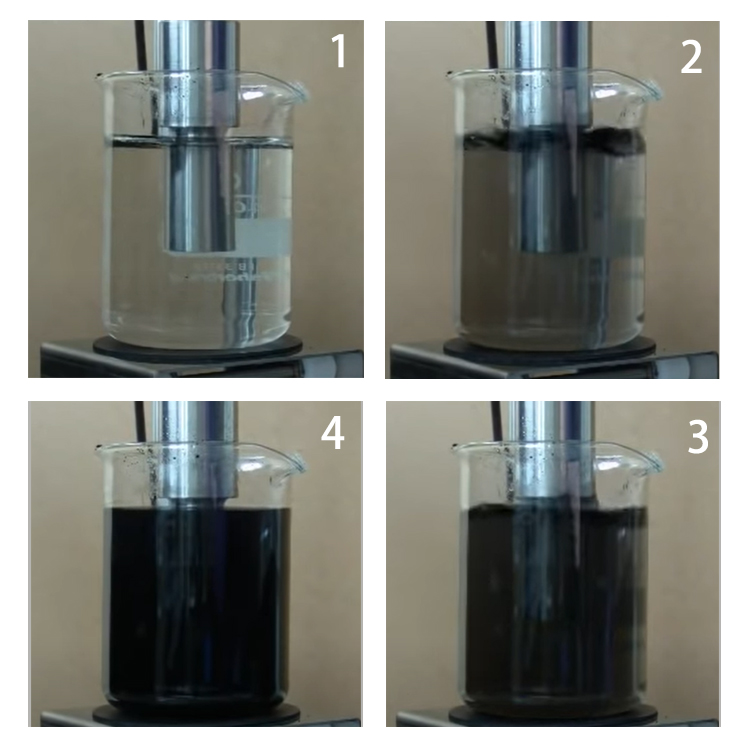
Our ultrasonic dispersion equipment(ultrasonic homogenizer) effectively exfoliates individual tubes or small bundles to establish a three-dimensional conductive network. Compared to traditional milling, ultrasonic dispersion preserves the high aspect ratio of the nanotubes, reduces slurry viscosity, and increases solid content; this ultimately lowers internal battery resistance and enhances rate performance.
2. Nanomaterials: Graphene and Silica Dispersion
Ultrasonic waves are highly effective at overcoming the van der Waals forces between graphene layers to achieve exfoliation without oxidizing the edges. For hard-agglomerated particles like silica, the cavitation effect effectively breaks down “hard agglomerates,” thereby improving the precision and stability of polishing fluids and coatings.
3. Biomedicine: Protein Extraction and Cell Disruption
Ultrasonic physical shear forces are used to disrupt cell walls and release intracellular proteins or peptides. The process is free from chemical contamination, and low-temperature control systems preserve biological activity, resulting in higher extraction yields.
4. Chemical Industry and Coatings: Pigment Dispersion and Anti-Settling
By increasing the Zeta potential, ultrasonic dispersion effectively prevents pigment settling, enhances the tinting strength and storage stability of coatings and inks, and reduces the required dosage of dispersing agents.
For more professional information, please visit www.hzpmsonic-en.com.
Post time: Aug-19-2026