
In laboratories or industrial workshops, a common and frustrating problem arises when powder poured into a liquid forms stubborn clumps; no matter how fast the stirrer spins, the interiors of these clumps remain dry. Hangzhou Precision Machinery Co.,Ltd. (JH) provides the ultrasonic disperser—a device powered by high-frequency sound waves—can often solve this dilemma. It achieves uniform particle dispersion through physical vibration alone, without the need for heat or chemical additives.
What exactly is an ultrasonic disperser? Its core component is a transducer that converts electrical energy into mechanical vibrations occurring at a rate of over 20,000 cycles per second. These vibrations propagate through the liquid, creating alternating zones of compression and rarefaction. In the rarefaction zones, a multitude of tiny vacuum bubbles form instantaneously within the liquid; during the subsequent compression cycle, these bubbles violently collapse, generating localized high-pressure shock waves. This process, known as the “cavitation effect,” is the primary mechanism behind the disperser’s operation.
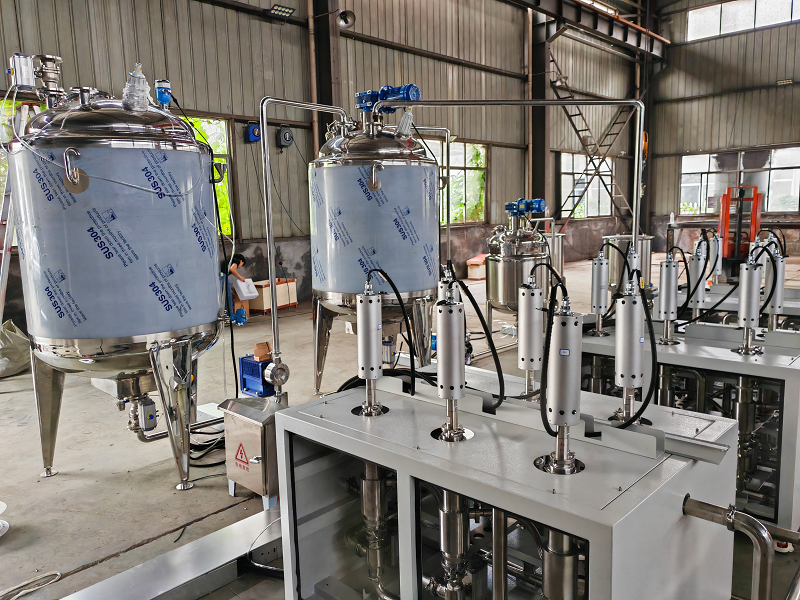
Function 1 is breaking up agglomerates. Many nanomaterials (such as titanium dioxide and carbon nanotubes) form hard clumps after drying due to van der Waals forces or electrostatic interactions between particles. Conventional stirring cannot provide sufficient shear force, whereas the shock waves generated by cavitation act directly on particle interfaces, breaking down agglomerates into their original primary particle sizes. For instance, in paint manufacturing, using this equipment to process color pastes ensures uniform pigment suspension, preventing color blotches in the final product.
Function 2 is facilitating liquid-liquid mixing. When two immiscible liquids (such as oil and water) must be turned into an emulsion, the micro-jets generated by the ultrasonic disperser force droplets to repeatedly deform and shatter, creating uniform emulsion droplets with diameters of less than 1 micrometer. This physical emulsification method is gentler than traditional colloid milling and is particularly suitable for biological samples containing proteins or active enzymes, as the vibration process causes no significant temperature rise and does not damage molecular structures.
Function 3 is assisting with extraction and chemical reactions. In the extraction of active plant ingredients, the cavitation effect disrupts cell walls, allowing intracellular substances to be rapidly released into the solvent. Compared to the thermal reflux method, this approach shortens extraction time and reduces solvent consumption. In chemical synthesis, ultrasonic dispersers can accelerate reactions through localized high temperatures and pressures (reaching several thousand Kelvin during the instant of bubble collapse) while utilizing acoustic streaming effects to enhance mass transfer and ensure more thorough contact between reactants.
When using an ultrasonic disperser, proper parameter matching is essential. Excessive power may over-fragment particles or even alter the material’s crystal structure. Frequency selection dictates cavitation intensity: low frequencies (20–25 kHz) are suitable for processing large volumes of material, whereas high frequencies (40–60 kHz) are better suited for fine dispersion. Additionally, factors such as probe immersion depth, liquid viscosity, and temperature influence performance; consequently, small-scale trials are typically conducted before scaling up to production levels.
Regarding limitations and alternatives: cavitation bubbles struggle to form in high-viscosity slurries (such as resin pastes), leading to reduced dispersion efficiency; in such cases, mechanical stirring can be used for pre-mixing. Materials susceptible to oxidation require processing under an inert gas atmosphere, as free radicals generated by cavitation may trigger side reactions. For higher throughput requirements, a continuous-flow reactor setup can be employed, allowing the material to circulate through the probe zone.
Post time: Sep-16-2026