
Selecting the ideal ultrasonic sonochemical processing system requires a rigorous engineering evaluation of acoustic energy density, fluid rheology, batch kinetics, and continuous flow hydrodynamics. Mismatches between generator power ratings, ultrasonic homogenizer operating frequencies, and sample processing volumes frequently lead to incomplete particle de-agglomeration, emulsion instability, excessive heat build-up, and costly bottlenecks during commercial scale-up. Investing in certified laboratory ultrasonic homogenizer equipment establishes a dependable, mathematically sound baseline that allows formulation researchers to accurately determine specific energy inputs before transitioning recipes to pilot and full-scale manufacturing. Hangzhou Precision Machinery Co., Ltd. (JH) designs and manufactures an extensive catalog of laboratory, pilot-scale, and industrial ultrasonic liquid processors engineered to deliver repeatable acoustic cavitation across diverse research and commercial production environments.
Drawing from 15 years of precision ultrasonic homogenizer manufacturing and fluid cavitation engineering at JH, navigating the ultrasonic homogenizer selection process requires analyzing five essential technical criteria:
- 1. Power Rating and Volumetric Energy Density: Selecting appropriate generator wattage from 500W benchtop units to 3.0kW industrial flow-cell reactors based on specific energy per milliliter.
- 2. Operating Frequency and Cavitation Intensity: Understanding why 20kHz serves as the optimal industrial standard for deep shear cavitation compared to higher megasonic frequencies.
- 3. Batch Immersion vs Continuous Recirculation Flow Modes: Determining whether stationary beaker sonication, 5L to 20L pilot circulation loops, or pressurized inline flow cells fit your throughput targets.
- 4. Fluid Rheology, Viscosity, and System Pressure Limits: Evaluating equipment capability to process viscous media up to 6,000 cP and sustain hydraulic operating pressures up to 0.6 MPa.
- 5. Temperature Dissipation, Metallurgy, and Sanitary Standards: Verifying medical-grade titanium alloy probes, 316L stainless steel wetted parts, double-jacket cooling, and CIP/SIP cleaning compatibility.
Matching Acoustic Power and Energy Density to Processing Volumes (500W to 5.0kW)
The primary technical specification when evaluating an ultrasonic homogenizer is nominal generator power output, typically rated from 500W to 5,000W. However, effective homogenization is governed not merely by total wattage, but by acoustic power density—the amount of acoustic energy delivered per unit volume of fluid (Watts per milliliter or Joules per gram). Under-powered systems fail to generate sufficient acoustic intensity to exceed the cavitation threshold, while over-powered batch sonicators generate excessive acoustic decoupling and thermal hot spots.
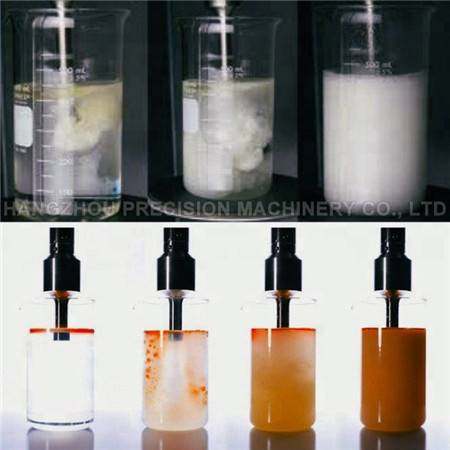
JH laboratory ultrasonic homogenizers span 500W, 800W, 1000W, and 1500W ratings, ideally configured for processing sample volumes from 10 milliliters up to 2500ml per batch in research and formulation prototyping. For benchtop feasibility screening, these lab-scale units can be equipped with specialized soundproof enclosures to isolate acoustic noise and feature a lightweight, compact footprint (around 6kg on dedicated models) for seamless benchtop mobility. For high-volume manufacturing environments, JH industrial liquid processors deliver 2.0kW, 3.0kW and 5.0kW continuous acoustic power directly into pressurized flow chambers. This broad power spectrum ensures that processing engineers can maintain exact volumetric energy density thresholds as fluid volumes scale from beaker trials to commercial production streams.
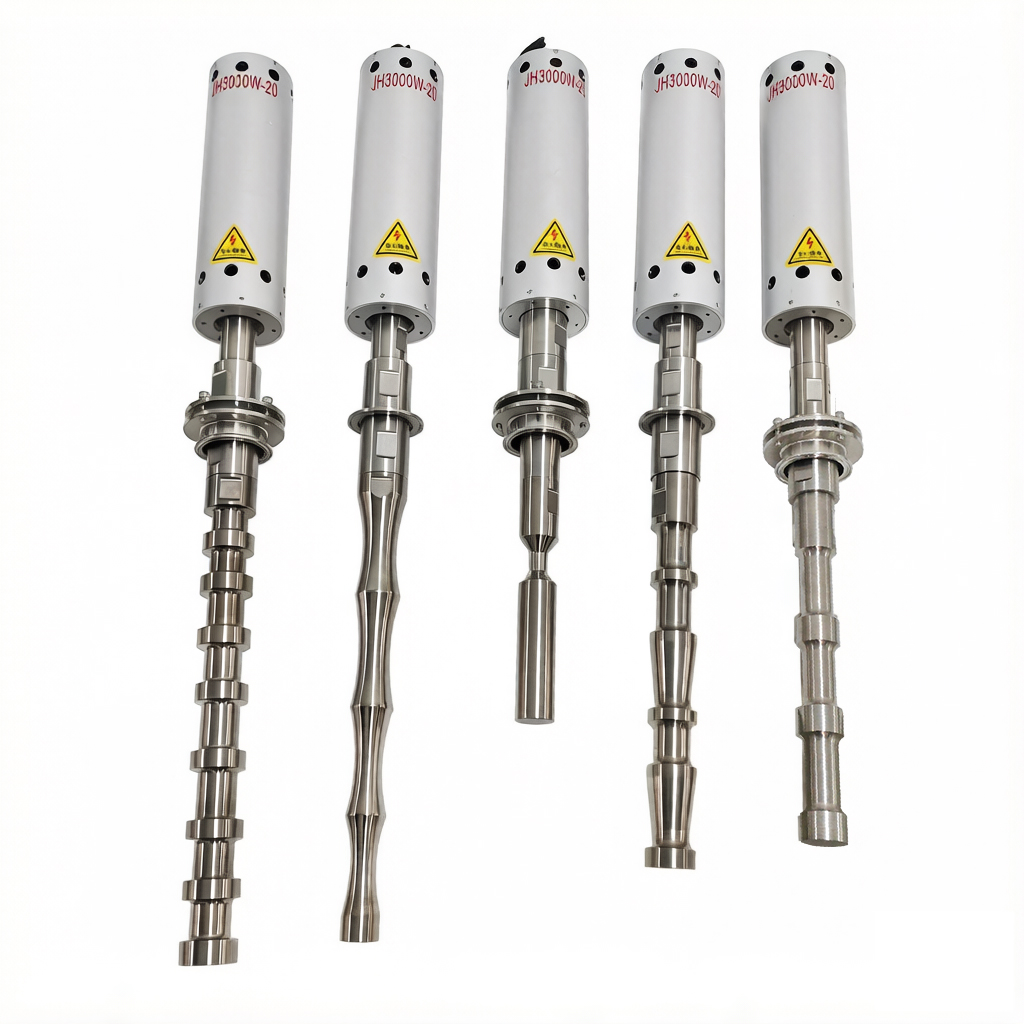
Frequency Selection: Why 20kHz Remains the Industrial Standard for Liquid Cavitation
Ultrasonic processing frequencies range from 20kHz up to several megahertz, but liquid processing and mechanical homogenization universally standardize on 20kHz. Acoustic physics dictates an inverse relationship between frequency and cavitation bubble size: lower frequencies around 20kHz generate relatively large transient cavitation bubbles that collapse with enormous mechanical violence. These 20kHz bubble implosions produce localized shockwaves and micro-jets traveling over 1,000 km/h with localized temperatures reaching 5,000 Kelvin, generating the extreme shear forces required to shatter agglomerates and disrupt cellular membranes.
Higher frequencies produce tiny, gentle cavitation bubbles suitable for delicate surface cleaning, but lack the mechanical shear energy needed for nanoparticle dispersion or sub-micron emulsification. JH engineers its entire core lineup of laboratory, pilot, and industrial liquid processing equipment around 20kHz acoustic resonance, ensuring maximum cavitation shearing efficiency and seamless linear scale-up across advanced materials—including graphene, carbon nanotubes, liposomal vitamin C, nanosilica, and functional biodiesel emulsions.
Batch Beakers vs Closed Flow-Cell Recirculation Loops (5L to Multi-Ton Scaling)
Choosing between static batch sonication and continuous inline flow-cell processing depends on target production volume, residence time distribution, and quality consistency. Static batch probe sonication is ideal for small-volume academic research, cell lysis, and early formulation feasibility screening in open or sealed beakers up to 2.5 liters. However, as batch volumes exceed 5 liters, static vessels suffer from uneven acoustic exposure, where fluid near the probe tip receives intense cavitation while peripheral fluid remains unprocessed.
To overcome batch dead zones, JH manufactures small-scale pilot recirculation systems in 5L, 10L, and 20L capacities featuring progressive cavity feed pumps and flow-through acoustic chambers. Recirculating fluid through a dedicated flow cell ensures that 100% of the formulation passes directly through the high-intensity cavitation zone multiple times. For commercial multi-ton production lines, JH industrial flow-cell homogenizers integrate directly into continuous production pipelines, providing uniform acoustic residence time and eliminating batch-to-batch variation.
Viscosity, Pressure, and Dynamic Amplitude Control Parameters
Fluid rheology strongly influences cavitation dynamics. High-viscosity fluids resist acoustic bubble formation, dampening acoustic wave propagation and requiring higher mechanical amplitude to initiate cavitation. Standard laboratory sonicators often stall or lose resonance when introduced to heavy polymers, battery slurries, or thick cosmetic creams. JH industrial ultrasonic systems feature robust automatic frequency-tracking digital generators capable of maintaining stable acoustic resonance in viscous fluids up to 6,000 cP.
In addition, applying hydraulic backpressure inside a sealed flow cell intensifies cavitation bubble collapse, increasing shear stresses and accelerating droplet breakup. JH heavy-duty flow-cell homogenizers operate safely under continuous system working pressures up to 0.6 MPa. Integrated digital generator controls allow operators to adjust ultrasonic amplitude steplessly between 30% and 100%, providing the operational flexibility needed to process delicate shear-sensitive polymers as well as abrasive mineral slurries.
Temperature Dissipation and Sanitary Contact Metallurgy (Titanium and 316L)
Nearly all acoustic energy introduced into a fluid eventually converts into thermal energy, causing rapid temperature rise that can degrade heat-sensitive bioactives, pharmaceutical proteins, food nutrients, or battery binders. Effective temperature management is therefore a vital selection factor. JH pilot circulation systems and industrial flow cells incorporate double-jacketed cooling chambers that circulate chilled water or glycol, dissipating process heat in real time and maintaining fluid temperatures consistently below 100°C during continuous processing.
Contact metallurgy is equally critical for preventing product contamination and resisting corrosive attack. JH ultrasonic horns and probes are precision-machined from certified medical-grade titanium alloy, offering exceptional acoustic transmission efficiency, high fatigue strength, and complete resistance to cavitation erosion. All flow chambers, sanitary flanges, and circulation pipework are fabricated from electropolished 304 and 316L stainless steel, ensuring complete compliance with Clean-in-Place (CIP) and Sterilize-in-Place (SIP) hygienic standards across food, cosmetic, and pharmaceutical manufacturing plants.
Conclusion
Selecting the right ultrasonic homogenizer requires a balanced alignment of acoustic power, 20kHz resonance stability, continuous flow-cell engineering, viscosity handling, and sanitary metallurgy. With 15 years of dedicated acoustic engineering expertise, CE certification, and trusted by global industry leaders such as Nippon Paint and L’Oréal, JH provides academic institutions, research centers, and global manufacturing enterprises with a proven, scalable pathway for advanced liquid sonochemistry. Every JH system is backed by a 2-year warranty, dedicated lifetime technical support, and precision engineering for 24-hour continuous industrial duty.
To request detailed technical specifications for 500W to 1500W laboratory sonicators, 5L to 20L pilot recirculation testbeds, or industrial 3.0kW flow-cell homogenizers, visit the official company portal: https://www.hzpmsonic-en.com/. For direct engineering consultations regarding power density calculations, frequency matching, flow-cell sizing, and customized production skid integration for your laboratory or commercial facility, contact the technical sales department.
Post time: Sep-16-2026