
Particle size reduction in liquid processing directly determines dispersion stability, chemical reactivity, optical clarity, and product functionality across advanced materials and chemical formulations. For industrial processing facilities seeking to transition from macro-emulsions to true nanoscale dispersions, choosing between conventional rotor-stator high shear mixers and an ultrasonic homogenizer for particle size reduction represents a fundamental engineering decision. Hangzhou Precision Machinery Co., Ltd. (JH) manufactures specialized liquid processing systems designed to address these complex rheological and deagglomeration challenges across global manufacturing sectors.
Drawing from 15 years of ultrasonic liquid processing engineering at JH, four primary technical parameters evaluate how ultrasonic cavitation systems and mechanical high shear mixers address distinct particle reduction requirements:
- Deagglomeration Mechanics: Rotor-Stator Shear vs ultrasonic Cavitation: Evaluating physical fluid shear forces versus localized micro-jet velocities exceeding 1,000 km/h generated by ultrasonic cavitation.
- Particle Size Limits and Polydispersity Index (PDI): Comparing the conventional 1 to 5 micron milling limit of mechanical shear against sub-micron and nanoscale particle reduction below 100 nanometers.
- Energy Efficiency and Viscosity Processing Boundaries: Analyzing targeted ultrasonic energy delivery against bulk hydraulic friction losses in fluid systems with viscosities up to 6,000 cP.
- Thermal Control and Temperature-Sensitive Formulation Preservation: Evaluating heat generation and in-line jacketed cooling capabilities during high-throughput continuous manufacturing.
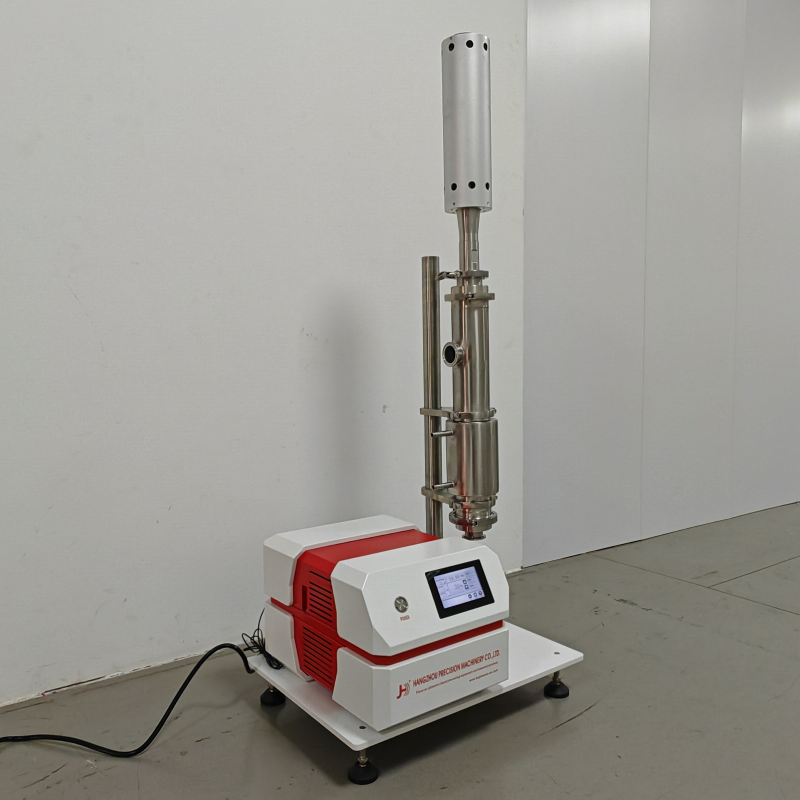
Rotor-Stator Mechanical Shear vs Ultrasonic Acoustic Cavitation Mechanics
High shear mixers operate by rotating an internal slotted rotor at high tip speeds, typically between 10 and 40 meters per second, inside a stationary stator. Fluid entering the mixing head is forced outward through narrow stator slots, subjecting solid aggregates and liquid droplets to intense mechanical shear, centrifugal acceleration, and hydraulic turbulence. While effective for initial bulk blending, solid wetting, and coarse macro-emulsification, mechanical shear forces diminish rapidly as particle dimensions shrink, because smaller particles navigate streamline flow around rotor blades without experiencing sufficient rupture stress.
Ultrasonic homogenizers utilize high-frequency acoustic waves, operating at 20kHz, transmitted into the liquid medium through a high-strength titanium alloy horn. The alternating high-pressure and low-pressure acoustic cycles create microscopic vapor bubbles that grow until reaching unstable dimensions, collapsing violently within nanoseconds. This acoustic cavitation phenomenon generates localized shock waves, localized temperatures of several thousand Kelvin, and liquid micro-jets traveling at velocities exceeding 1,000 km/h. These localized hydrodynamic shear forces break tough intermolecular van der Waals bonds, deagglomerating carbon nanotubes, graphene sheets, and sub-micron ceramic particles that mechanical blades cannot divide, delivering complete particle separation throughout the liquid volume.
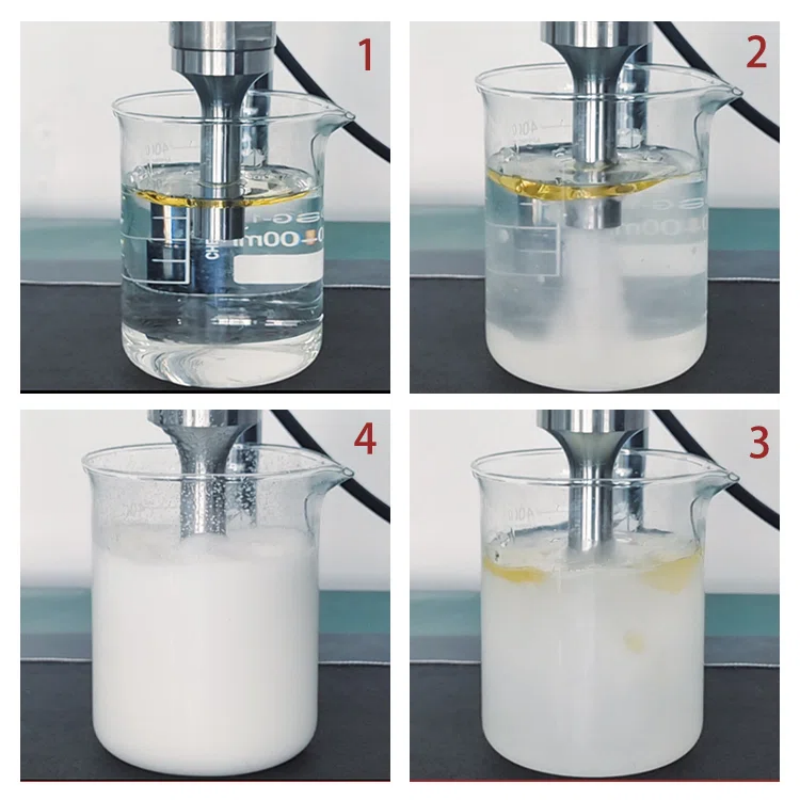
Particle Size Boundaries: Reaching Sub-Micron and Nanoscale Dispersions
The physical limitation of high shear mixers creates a particle reduction plateau around 1 to 5 microns in most industrial fluid formulations. Extended recirculation through a high shear head often yields diminishing returns, as mechanical shear energy dissipates as parasitic fluid heat rather than fracturing solid particles. Additionally, mechanical shear frequently generates a broad polydispersity index (PDI), leaving large outlier agglomerates that precipitate over time, destabilizing high-grade coatings, advanced battery slurries, and pharmaceutical suspensions.
JH industrial ultrasonic equipment overcomes this physical threshold, consistently achieving sub-micron and true nanoscale particle distributions below 100 nanometers with exceptionally narrow PDI curves. Because acoustic cavitation energy concentrates at the exact point of bubble implosion, particle fracture occurs uniformly throughout the continuous flow stream. This narrow particle size distribution prevents sedimentation in conductive inks, improves active ingredient bioavailability in cosmetic nanoemulsions, and enhances electrochemical conductivity in lithium battery cathode slurries, providing long-term dispersion stability.
Energy Efficiency, Viscosity Handling, and 24-Hour Continuous Duty
From an operational efficiency perspective, conventional high shear mixers consume significant electrical power rotating massive mechanical assemblies through high-viscosity media. A large portion of this energy converts into bulk hydraulic drag and turbulent fluid friction rather than targeted particle breakage. In contrast, JH ultrasonic homogenizers deliver focused electrical-to-acoustic energy conversion with precise amplitude adjustment ranging from 10 to 70 µm, directly targeting the fluid medium with minimal mechanical friction losses across continuous industrial processing lines.
JH ultrasonic processing systems handle fluid media with viscosities up to 6,000 cP under operating pressures up to 0.6 MPa and bearing temperatures from 0 to 100°C. Equipped with intelligent real-time automatic frequency tracking generators and multiple internal overload protection mechanisms, JH 20kHz systems deliver stable energy output for 24/7 continuous industrial duty with a service life exceeding 5 years. Supporting both static batch and inline circulation modes, these energy-focusing designs improve processing efficiency significantly without mechanical seal wear or blade erosion.
Thermal Management and Temperature-Sensitive Active Compound Protection
Thermal buildup represents a significant processing challenge when dispersing active pharmaceutical ingredients, cosmetic liposomes, botanical extracts, or heat-sensitive polymers. High shear mixers generate substantial bulk friction heat in closed mixing tanks during extended recirculation cycles, which can denature proteins, degrade active botanicals, or trigger premature polymer cross-linking if batch cooling capacity is insufficient.
JH integrates ultrasonic homogenizers with continuous jacketed flow-through reactors and modular circulation tanks. Because fluid resides in the high-intensity cavitation zone for only a fraction of a second during each pass, cooling jackets efficiently dissipate thermal energy, maintaining formulation temperatures below critical degradation limits. This precise thermal management makes ultrasonic homogenization ideal for temperature-sensitive botanical extraction, CBD oil nanoemulsions, and enzyme cell disruption across laboratory and pilot plant operations, protecting sensitive active compounds from thermal degradation.
Single-Source Ultrasonic Engineering Advantages of Direct Factory Partnerships
Partnering directly with a specialized ultrasonic liquid processing manufacturer gives industrial formulation chemists and engineering teams access to verified titanium alloy sonotrodes, digital automatic frequency tracking generators, modular flow cell reactors, and scalable processing architectures. This focused engineering approach accelerates production validation and scale-up compared to relying on generic equipment distributors that lack acoustic modeling software, application testing laboratories, and custom horn fabrication capabilities.
JH engineers provide custom horn geometries, tool head lengths, and standardized flange mounting that integrate seamlessly into existing customer vessels and process pipelines. Backed by an in-house engineering team and dedicated testing facilities, JH provides customers with complete application support spanning graphene exfoliation, nano-alumina dispersion, cosmetic emulsification, and cell disruption, ensuring that every industrial deployment achieves optimal processing efficiency and reliable long-term performance.
Conclusion and Industrial Ultrasonic Processing Sourcing Portal
Selecting between high shear mixing and ultrasonic homogenization depends on target particle dimensions, dispersion stability requirements, and formulation rheology. While high shear mixers serve broad bulk blending tasks, ultrasonic homogenizers provide the acoustic cavitation intensity necessary for sub-micron deagglomeration, narrow particle size distribution, and true nanoscale processing. With 15 years of specialized manufacturing experience, CE certification, and an extensive product line ranging from 500W laboratory units to 3kW industrial continuous-flow systems, JH delivers robust ultrasonic solutions for modern industrial fluid processing across global advanced manufacturing sectors.
To request industrial ultrasonic homogenizer technical specifications, flow cell dimensional drawings, application test data, or custom system quotations for your production lines, visit the official company portal: https://www.hzpmsonic-en.com/. For direct engineering consultations regarding acoustic cavitation parameters, amplitude optimization, flow cell configuration, and pilot-scale trials, contact the technical sales department.
Post time: Aug-27-2026