
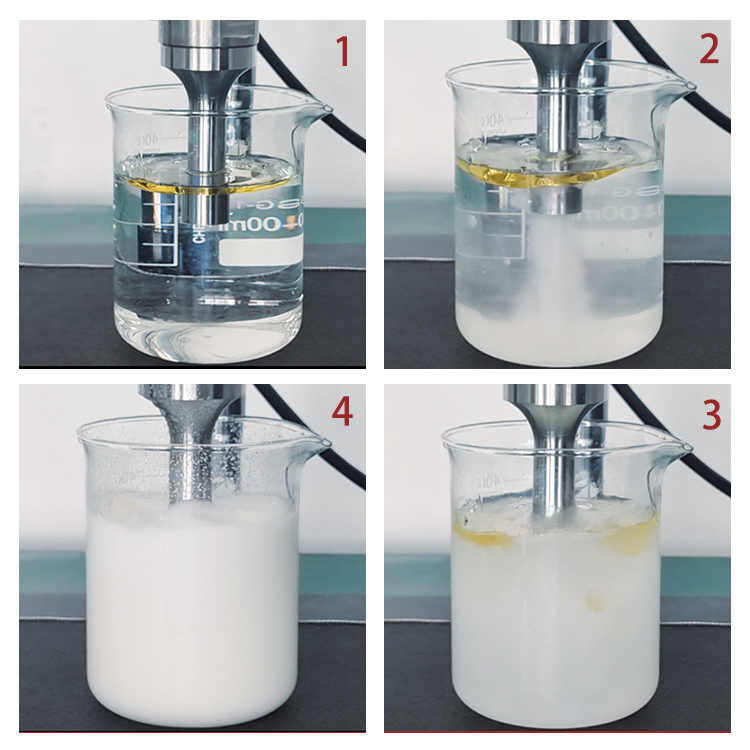
Ultrasonic oil-water emulsification is a technique that utilizes ultrasonic energy to facilitate the formation of a stable emulsion from immiscible liquids. This process primarily involves the mixing of oil and water phases; under the influence of ultrasonic waves, oil droplets are dispersed into extremely fine particles and uniformly distributed within the aqueous phase to form an emulsion.
The basic procedure for ultrasonic oil-water emulsification is as follows:
1. Preparation of raw materials:
- Select the required oil and water phase materials.
The oil phase typically consists of various types of oils or fats, such as vegetable oil, mineral oil, or synthetic oil; the water phase consists of water or an aqueous solution containing surfactants.
- If necessary, an appropriate amount of surfactant may be added to the water phase to reduce interfacial tension between the oil and water, thereby facilitating the emulsification process.
2. Pre-treatment:
- Pre-heat the oil and water phases to raise their temperatures and lower their viscosities, which benefits the ultrasonic emulsification process.
- Clean the ultrasonic probe or emulsification apparatus to ensure no residual substances interfere with the emulsification results.
3. Mixing:
- Combine the oil and water phases according to a predetermined ratio.
The mixing ratio depends on the requirements of the final product; generally, the water phase exceeds the oil phase in volume.
- Use a mechanical stirrer for preliminary mixing to blend the oil and water phases roughly, creating coarse emulsion droplets.
4. Ultrasonic treatment:
- Place the mixed oil-water mixture into the processing tank of the ultrasonic emulsification equipment.
- Adjust the frequency and power of the ultrasonic generator to produce high-frequency ultrasonic waves.
- The ultrasonic waves are transmitted into the oil-water mixture via the probe, generating a cavitation effect—whereby tiny bubbles form and rapidly collapse within the liquid—producing intense shear forces.
- These shear forces break down oil droplets into smaller particles and distribute them uniformly within the aqueous phase, forming a stable emulsion.
5. Circulation and Homogenization:
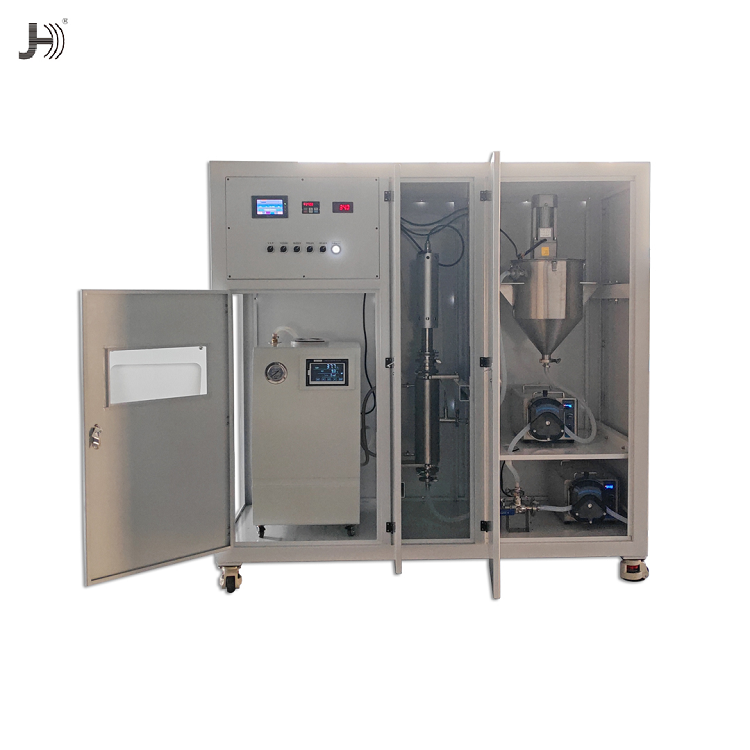
- During ultrasonic processing, a circulation system can be used to continuously pass the oil-water mixture through the ultrasonic probe, ensuring that every part of the mixture undergoes thorough emulsification.
- Ultrasonic processing can be repeated multiple times as needed to achieve the desired emulsification results.
6. Cooling and Stabilization:
- Once emulsification is complete, the emulsion can be cooled to room temperature to stabilize the emulsified state.
- Some degree of separation may occur during cooling; stability can be restored through appropriate agitation.
7. Quality Testing:
- Quality testing is performed on the resulting emulsion, covering parameters such as particle size distribution and emulsification stability.
- Based on the test results, ultrasonic parameters may be adjusted or appropriate amounts of stabilizers added to meet product quality requirements.
8. Packaging and Storage:
- The emulsion meeting quality standards is packaged and labeled with information such as the production date and expiration date.
- It should be stored in a cool, dry place, away from high temperatures and direct sunlight, to maintain the emulsion’s stability.
Post time: Jul-03-2026