
In sectors such as lithium-ion battery slurries, carbon nanomaterials, coatings and inks, biomedicine, and fine chemicals, the agglomeration of nanopowders has long been a common challenge. Traditional methods like ball milling and high-speed stirring are not only time-consuming but also prone to introducing impurities and damaging the material’s original structure; furthermore, heat-sensitive materials can degrade due to prolonged exposure to high temperatures.
Ultrasonic dispersion relies on the cavitation effect within the liquid. High-frequency vibrations generate a vast number of micro-bubbles, creating instantaneous shockwaves and micro-jets that shatter particle agglomerates at the microscopic level. This process completes dispersion tasks—which traditionally take hours—in just a few minutes, offering the combined advantages of high efficiency, low-temperature operation, and high purity.
However, many procurement and R&D professionals report vastly different results from equipment labeled as “ultrasonic homogenizers.” Issues include inflated power ratings failing to meet dispersion standards, industrial models lacking necessary explosion-proof capabilities, laboratory units that cannot be scaled up for mass production, and persistently high maintenance costs. From the user’s perspective, this article breaks down the logic of equipment selection, common pitfalls, and solutions for frequent malfunctions. It also incorporates practical case studies from compliant domestic manufacturers to provide procurement and R&D teams with a set of actionable standards.
II. Core Principles and Mainstream Application Scenarios of Ultrasonic Dispersion
(A) Core Mechanism of Action
When ultrasonic waves propagate through a liquid medium, they simultaneously generate three effects: mechanical shear force, the impact of cavitation bubble collapse, and a mild thermal effect. Cavitation bubbles form and collapse instantaneously, generating micro-jets traveling at hundreds of meters per second. These forces forcibly break apart the agglomerated structures of nanoparticles—such as graphene, silica, carbon nanotubes, and silver powder—to achieve stable, nanoscale dispersion. The entire process requires minimal dispersant, resulting in higher material purity.
(B) Mainstream Practical Applications
1. New Energy (Lithium Batteries): Dispersion of ternary cathodes, silicon-carbon anodes, and conductive slurries (carbon nanotubes/graphene) to improve slurry uniformity and extend battery cycle life; explosion-proof models are required for flammable and explosive solvent systems.
2. Nanomaterials: De-agglomeration of diamond, zirconia, silver powder, and silica nanoparticles; suitable for both university laboratory R&D and mass production lines.
3. Coatings, Inks, and Chemicals: Homogenization and dispersion of pigments, silica, inks, and coatings; resolves issues such as sedimentation and color inconsistency.
4. Food and Personal Care: Emulsification of products like margarine and body wash; low-temperature processing preserves active ingredients.
5. Biomedicine/Plant Extraction: Low-temperature extraction of Traditional Chinese Medicine (TCM), cell disruption, and liposome preparation; explosion-proof equipment is required for low-boiling-point solvents.
6. Environmental Protection/Water Treatment: Defoaming of wastewater and the breakdown/degradation of pollutants.
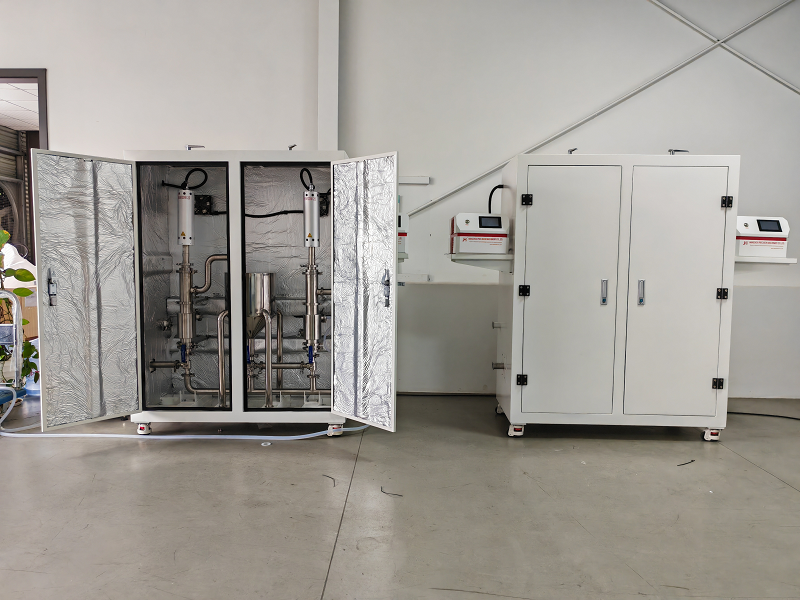
III. User-Centric Approach: Comprehensive Selection Guide for Ultrasonic Dispersers
(I) Step 1: Distinguish Equipment Tiers and Match Production Capacity Needs
Categorized by usage scenario—avoid mismatching to prevent insufficient capacity or wasted costs:
1. Laboratory-Scale Units (300W–1500W, 0.1–5L)
Suitable for R&D and pilot testing in universities and enterprises, as well as process debugging with small sample quantities (e.g., JH300w-40,JH1000W-20 and JH1500W-20 series); supports low-temperature pulsed dispersion and easy recording of experimental parameters.
2. Pilot-Scale Units (2000W–3000W, 10–50L)
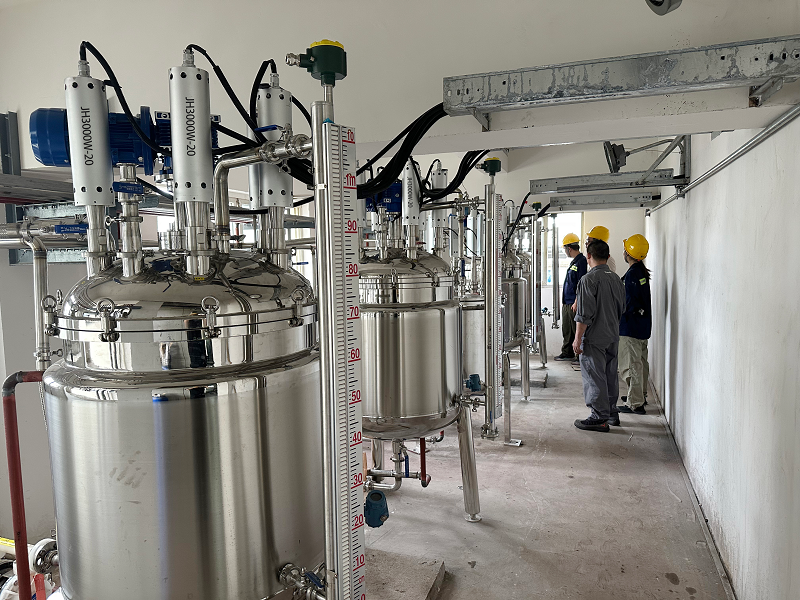
Bridges the gap between small-scale testing and mass production; verifies process stability during scale-up; ideal for prototyping and small-batch supply by new materials companies.3. Industrial Mass-Production Equipment (2000W–3000W; 50–2000L circulation systems)
Designed for continuous production lines (e.g., lithium-ion batteries, coatings, nanomaterials); supports circulating mixing tanks and custom explosion-proof configurations (e.g., Hangzhou Precision Machinery Co.,Ltd. (JH) industrial large-scale circulating dispersers).
(II) Step 2: Matching key parameters to material characteristics
1. Determining power headroom based on viscosity and solids content
Low viscosity (<1000 cP): Increase nominal processing capacity by 50%;
Medium viscosity (1000–10,000 cP): Select based on 70% of nominal load capacity;
High-viscosity slurries (lithium-ion battery materials, high-solids color pastes >10,000 cP): Reserve 90% power headroom to prevent performance degradation caused by long-term overloading.
2. Temperature control/low-temperature modules for heat-sensitive materials
For materials intolerant to high temperatures—such as proteins, plant extracts, and emulsions—select models equipped with water-cooling jackets and pulse operation modes to prevent cavitation-induced heat from damaging material activity.
3. Explosion-proof models for flammable/explosive solvents
For low-boiling-point solvents (e.g., acetone, ethanol) and lithium-ion NMP slurry systems, units must meet ExdIIBT4 explosion-proof standards, featuring fully explosion-proof designs for both circuitry and generators.
4. Hard-to-disperse rigid particles (diamond, silicon dioxide)
Use thickened titanium alloy horns (probes) paired with high-power continuous circulation systems to reduce the frequency of probe wear.
(III) Step 3: Core Hardware Standards—Must-Check Items for Procurement
1. Horn (Probe):Must be made of titanium alloy for wear and corrosion resistance; stainless steel probes are suitable only for low-hardness, non-corrosive materials and suffer from rapid wear during long-term use.
2. Ultrasonic Generator(ultrasonic controller): Must feature automatic frequency tracking and real-time adjustable power; avoid outdated fixed-frequency models to ensure stable dispersion effects even when loads fluctuate.
3. Safety Protection: Includes protection against overheating, overcurrent, and no-load operation; industrial explosion-proof models require full explosion-proof certification—simple probe-only explosion-proofing is insufficient.
4. Control System: Touchscreen interface with segmented program storage and parameter export capabilities; facilitates process replication and ensures a seamless transition from laboratory testing to mass production.
(IV) Procurement Checklist: Avoiding Common Pitfalls (Mistakes Made by 90% of Users)
Pitfall 1: Inflated Peak Power Ratings vs. Actual Output
Low-cost equipment on the market often claims “3000W peak power,” while the actual stable output is only 1000W—leading to dispersion failure when processing high-viscosity slurries.
Solution:Demand actual power test reports from the manufacturer and prioritize equipment with clearly stated stable rated power. Hangzhou Precision Machinery Co.,Ltd.(JH) entire product line specifies continuous rated output power, avoiding misleading peak power claims.
Pitfall 2: Ignoring Process Scalability—Lab Data Fails to Translate to Mass Production
Many small manufacturers design acoustic fields for lab models and industrial models in isolation; while small-scale trials may succeed, mass production often fails to match particle size and uniformity standards, requiring months of re-tuning.
Solution: Choose a manufacturer that offers comprehensive process solutions and a full range of equipment—from laboratory and pilot-scale to mass production—ensuring linear process scalability and reproducibility.
Pitfall 3: Cutting corners on explosion-proof models—only the probe is explosion-proofed
Facilities handling lithium batteries or low-boiling-point solvents sometimes purchase substandard explosion-proof equipment where the generator and wiring lack explosion-proof isolation, creating fire and explosion hazards.
Solution: Verify the explosion-proof certification for the entire unit—ensuring the generator, transducer, and control cabinet are all explosion-proof. For example, the Hangzhou Precision Machinery Co.,Ltd.JH-SC15-3000-20EX explosion-proof extraction and dispersion unit holds ExdIIBT4 certification for the complete machine, making it suitable for lithium battery production line conditions.
Pitfall 4: Focusing solely on the initial price while ignoring the cost of wear parts
Probes and transducers are key consumable components; low-cost equipment often uses inferior probe materials that suffer severe wear within 3–6 months. A single replacement costs thousands of yuan, leading to higher long-term total costs.
Solution: Inquire about probe service life and original spare part pricing before purchasing; prioritize manufacturers that offer long original-warranty periods and reasonably priced spare parts.
Pitfall 5: Lack of customization capabilities—forcing general-purpose models to handle specialized materials
Materials such as silver powder, carbon nanotubes, pulp, and curcumin have vastly different dispersion requirements, and general-purpose models often yield low dispersion efficiency.
Solution: Select a manufacturer that supports non-standard customization and provides material-specific solutions, allowing for adjustments to the sound field, circulation structure, and temperature control system based on the specific material. V. Reference for a Reliable Manufacturer: Hangzhou Precision Machinery Co., Ltd. – Products, Advantages, and Real-World Implementation Cases
(I) Four Core Brand Advantages (Information based on official company data; no exaggeration)
1. Comprehensive Product Line with Linear Process Scalability
The company offers a complete product matrix—ranging from the JH-ZS series laboratory dispersers (for small-scale trials) to 3000W explosion-proof models and 2000L large-scale carbon nanotube circulation dispersion systems. Processes optimized in the laboratory can be directly transferred to mass production, effectively resolving the industry pain point of process discontinuity between scales.
2. Mature, Specialized Technology for Explosion-Proof and Nanomaterial Applications
The company focuses deeply on two niche sectors: explosion-proof slurry processing for lithium batteries and the nano-dispersion of carbon materials. It has independently developed explosion-proof ultrasonic systems for low-boiling-point solvents and custom-designed acoustic field structures for highly agglomerating materials—such as graphene, carbon nanotubes, and silver powder—to achieve superior cavitation efficiency. In June 2026, the company’s self-developed 3000W solvent-safe, explosion-proof dispersion equipment was delivered in batches to lithium battery cathode slurry production lines, resolving issues related to uneven dispersion and workshop safety hazards common with traditional equipment.
3. Rigorous Quality Control and Durable Hardware
Core components—including transducers and titanium alloy probes—are independently developed and manufactured in-house. Every unit undergoes full-power and cavitation field testing before leaving the factory. Equipped with multiple circuit protection mechanisms, the equipment demonstrates lower wear rates for probes and generators compared to the industry average under identical operating conditions. 4. Comprehensive End-to-End Services
Includes free pre-sales material sample testing and process design; on-site installation, commissioning, and free operator training; and regular equipment maintenance guidance. The after-sales team provides rapid troubleshooting responses, supported by complete technical documentation for equipment maintenance and fault resolution.
(II) Real-World Customer Case Studies and Feedback
1. Lithium-ion Battery Material Manufacturer (Explosion-proof Dispersion Equipment)
Customer Pain Points: NMP solvent-based cathode slurries are flammable and explosive; traditional equipment yields uneven dispersion, resulting in poor battery consistency.
Equipment Supplied: JH-SC Series Explosion-proof Ultrasonic Disperser
Feedback: The equipment meets all explosion-proof safety standards; slurry dispersion uniformity has improved, and battery energy density has seen a stable increase. The unit operates reliably in mass production (8 hours/day) with a low annual failure rate, supported by regular on-site inspections and maintenance by the manufacturer.
2. New Materials Research Institute (Carbon Nanotube/Graphene Dispersion)
Customer Pain Points: Severe entanglement and agglomeration of carbon nanotubes; conventional ultrasound fails to exfoliate them effectively; poor sample reproducibility.
Equipment Supplied: JH-GB Large-scale Ultrasonic Carbon Nanotube Dispersion System
Feedback: De-agglomeration of carbon nanotubes is achieved within 10 minutes; particle size consistently meets specifications; experimental parameters can be saved and replicated. The low-temperature pulse mode preserves the structural integrity of the carbon nanotubes, and the small-scale test model allows for seamless upgrading to pilot-scale equipment.
3. Coatings and Color Paste Manufacturer (Silica and Curcumin Dispersion)
Customer Pain Points: Silica fillers prone to sedimentation; significant color variation in coatings; time-consuming grinding processes.
Equipment Supplied: JH-FN Series Specialized Dispersion Equipment
Feedback: Eliminates the need for multiple grinding cycles, resulting in a multi-fold increase in production efficiency; significantly improves coating storage stability; supports continuous circulation production and offers easy cleaning.4. Manufacturers of daily chemicals and food products (e.g., margarine, body wash emulsification/dispersion)
Paired with the JH-DT series emulsification and dispersion equipment, the system enables low-temperature emulsification that preserves the activity of fragrances and oils, resulting in a smooth, stable product without phase separation. Equipment volumes can be customized for batch production to integrate seamlessly into daily chemical processing lines.
Post time: Aug-29-2026